
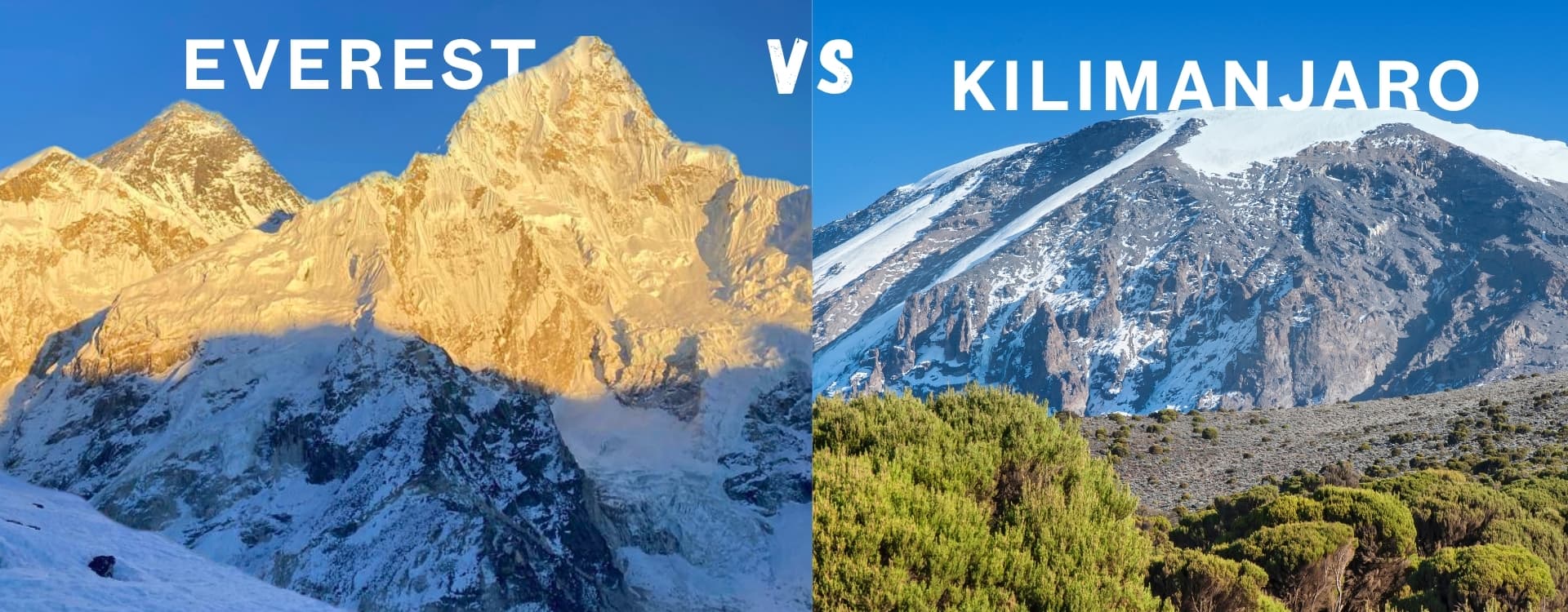
For a first-time high-altitude adventure, choose the Everest Base Camp (EBC) trek if you prioritise cultural immersion, better scenery, and a higher success rate (over 90%), or Kilimanjaro if you have limited time and want to tick off a true summit (5,895 m). EBC offers a 12-14-day tea-house experience in the Himalayas, while Kilimanjaro is a 5-9-day camping ascent through 5 ecological zones.
Choosing between Everest and Kilimanjaro depends on several factors such as cost, accommodation, acclimatisation, and route. As each has distinct strengths, choosing one requires careful consideration and planning.
The Everest Base Camp trek takes you to the foothills of the world's highest peak, while the Mount Kilimanjaro trek takes you to the top of the world's tallest free-standing mountain.
In this article, we will break down factors like difficulty, cost, altitude, and safety to help you decide which one to choose for your 2026 trek adventure.
Everest vs Kilimanjaro: Which Trek to Choose First?
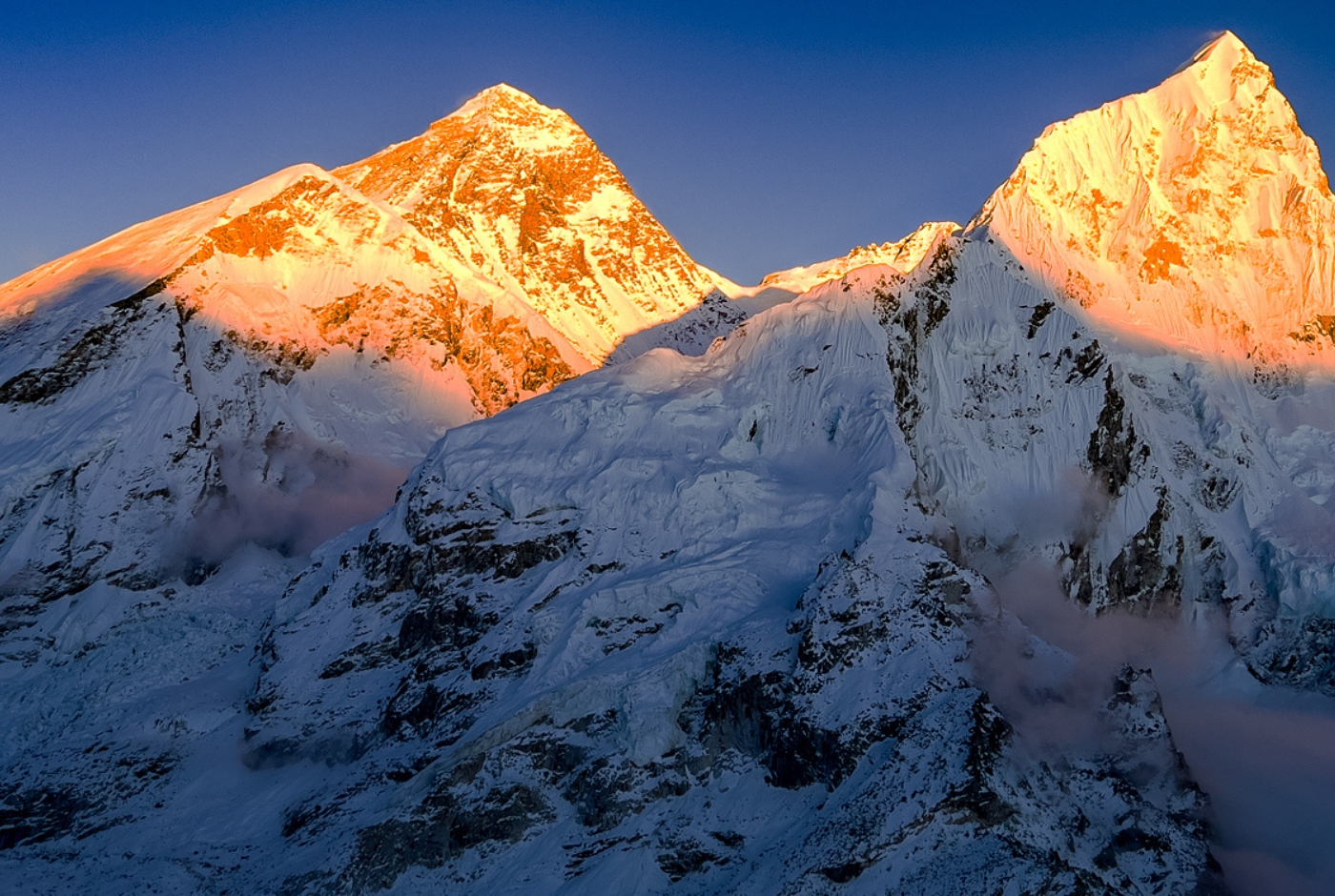
Choosing between Everest Base Camp (EBC) and Kilimanjaro depends on whether you prefer a longer, culturally rich endurance trek (EBC) or a shorter, intense summit climb (Kilimanjaro). EBC (12–14 days) offers teahouse comfort and Himalayan scenery, while Kilimanjaro (5–7 days) features rapid ascent through five climate zones. Most advise doing Everest Base Camp first to build experience with altitude and walking, as Kilimanjaro's final, high-altitude, nighttime ascent is more physically demanding.
Mount Kilimanjaro (5,895 m/19,341 ft) is a dormant stratovolcano, whereas Everest Base Camp is a journey to the base of the world's highest peak at 8,848.86 m (29,031 ft). The former is located in Tanzania, East Africa, and the latter lies on the Nepal-China border in the Himalayas.
Unlike most high-altitude peaks, Kilimanjaro does not belong to any mountain range. It is a free-standing volcanic massif rising from the open plains of northern Tanzania, near the border with Kenya, which is precisely why it holds the title of the world's tallest free-standing mountain. Mount Kilimanjaro is the highest peak on the African continent, making it a landmark of Africa and one of the Seven Summits alongside Aconcagua, Denali, Elbrus, Mont Blanc, Puncak Jaya, and Vinson Massif.
Both trekking routes are at tremendous heights, making them worth the attempt for every adventurous traveller.
Which is More Difficult, Everest or Kilimanjaro?
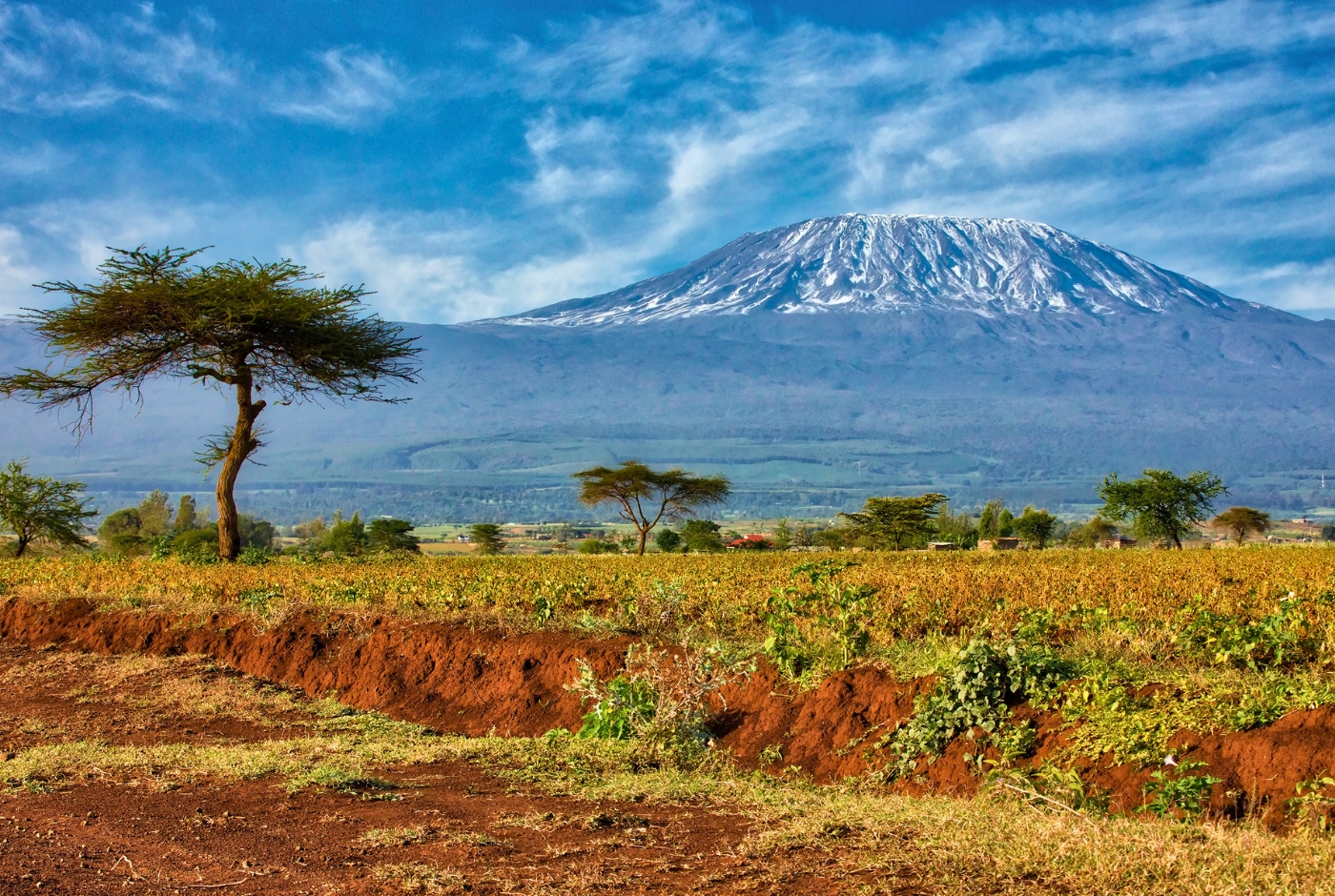
In terms of difficulty, Mount Kilimanjaro is more challenging than Mount Everest due to its steeper, faster, and higher-altitude ascent. Trekking the Kilimanjaro takes 5 to 7 days, while the Everest trek takes a minimum of 12 to 16 days.
The EBC trek offers a gradual ascent with better acclimatisation over a longer period, while Kilimanjaro involves a rapid ascent, which increases the risk of altitude sickness. Moreover, Mount Kilimanjaro involves a challenging midnight-to-sunrise ascent on the 6th and 7th day, which can be a major mental and physical challenge.
While both trails require basic fitness and proper preparation, Kilimanjaro's shorter timeframe makes it more difficult and riskier than the other.
In terms of total Kilimanjaro hike elevation gain, the ascent from the Machame Gate at 1,800 m to Uhuru Peak at 5,895 m covers roughly 4,095 m of vertical gain. By comparison, the EBC trail from Lukla to base camp involves approximately 2,500 m of elevation gain. This steep vertical climb over just a few days is one of the main reasons Kilimanjaro has a lower success rate on shorter routes.
Acclimatisation
Proper acclimatisation is crucial for both Mount Kilimanjaro (5,895 m) and the EBC trek (5,364 m) to prevent altitude sickness. It helps your body to naturally adapt to lower oxygen levels at higher altitudes.
While hiking Mount Kilimanjaro, trekkers may experience symptoms of altitude sickness, such as headaches, breathlessness, fatigue, and nausea, due to the rapid ascent. This is one of the key reasons contributing to its lower overall success rate.
The standard 12 to 16-day EBC itinerary includes mandatory rest days in Namche and Dingboche to allow trekkers' bodies to adjust before heading towards the base camp. Though trekkers may experience symptoms of altitude sickness, they tend to be milder.
Mount Kilimanjaro Vs Mount Everest Height
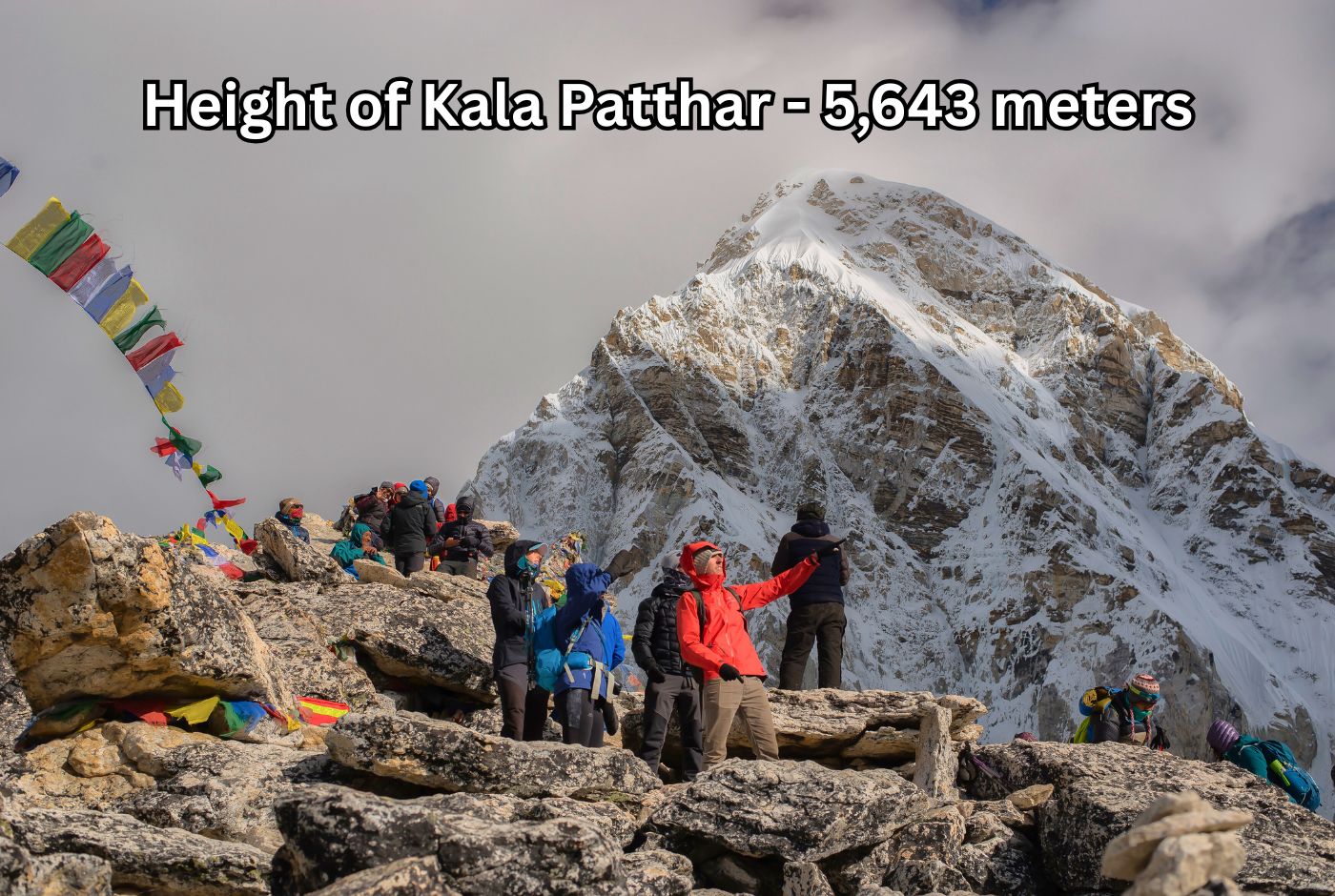
Mount Kilimanjaro, at 5,895 m (19,341 ft), is higher at its summit than the Everest Base Camp trek, which reaches 5,364 m (17,598 ft). Mount Everest stands at 8,848.86 m, but the highest point trekkers typically reach on the EBC trek is Kala Patthar at 5,643 m, known for its stunning sunrise views of Everest.
In short, climbing Kilimanjaro takes you roughly 500 m higher than trekking to Everest Base Camp. However, trekkers on the EBC route usually spend 4–5 nights above 4,000 m, which increases altitude exposure.
Despite being a non-technical climb, Mount Kilimanjaro involves greater vertical gain (from base to summit) than the elevation gain experienced on the Everest Base Camp trek.
Where Does Kilimanjaro Rank in Height in the World?
Mount Kilimanjaro at 5,895 m is the highest mountain in Africa and the world's tallest free-standing mountain, but it does not rank among the world's tallest peaks overall. The global top positions are dominated by Himalayan and Karakoram giants, with Mount Everest (8,848.86 m) leading the list, followed by K2, Kangchenjunga, Lhotse, and Makalu. Kilimanjaro's height ranking places it well outside the top 100 globally, but its status as an African landmark, a Seven Summits peak, and a non-technical climb makes it one of the most attempted high-altitude mountains in the world.
Kilimanjaro is not the second highest mountain in the world. That title belongs to K2 at 8,611 m in the Karakoram Range. Kilimanjaro is the highest peak on the African continent, which is a distinction entirely its own.
For further context, the highest point in the Himalayan mountains is Mount Everest at 8,848.86 m. K2, Mount Fuji, and Mount Kilimanjaro are not part of the Himalayan range. K2 belongs to the Karakoram, Fuji is a standalone volcano in Japan, and Kilimanjaro stands on the African continent.
Separately, the highest mountain peak in South America is Aconcagua at 6,961 m, located in Argentina. It is not Mount Everest, Kilimanjaro, or Mont Blanc. Aconcagua is part of the Seven Summits and stands significantly taller than Kilimanjaro.
How Many Mount Katahdins Make Up Mount Kilimanjaro's Height?
Mount Katahdin, the highest peak in Maine, USA, stands at 1,606 m (5,268 ft). To match Kilimanjaro's peak height of 5,895 m, you would need roughly 3.7 Mount Katahdins stacked on top of each other. In other words, Kilimanjaro is approximately 3.7 times taller than Mount Katahdin. This Mount Katahdin and Mount Kilimanjaro height comparison is frequently used to give trekkers from the northeastern United States a familiar frame of reference for just how high Kilimanjaro actually is.
Mount Kilimanjaro Vs Mount Everest Trekking Routes
Trekkers can book a guided trekking package with a reliable travel agency from the respective area. Though both of the treks are non-technical, trekkers should do basic fitness training a few months prior to the trek.
Route to Mount Kilimanjaro
Mount Kilimanjaro has seven trekking routes: Machame, Lemosho, Marangu, Rongai, Shira, Umbwe, and Northern Circuit. The shortest routes to the Kilimanjaro summit are Marangu and Umbwe, with only Marangu, "the tourist route", offering hut accommodation among all seven.
In addition, the Northern Circuit is the newest and longest route with the lowest foot traffic and the highest success rates.
In short, the most popular Marangu route looks like this: Marangu Gate - Mandara - Horombo Huts - Acclimatisation - Kibo Hut - Summit or Uhuru Peak (back to Horombo Hut) - Marangu Gate
Route to Everest Base Camp Trek
The trek to EBC starts with a domestic flight to Lukla (2,860 m), passing through local settlements such as Phakding, Namche Bazaar, Tengboche, Dingboche, and Lobuche, and eventually reaching the Everest Base Camp.
In addition, trekkers hike to Kala Patthar for a sunrise view of Mt Everest and descend via Pheriche, Pangboche, and Tengboche, then back to Namche Bazaar.
In short, the EBC route map looks like: Kathmandu - Lukla - Namche Bazaar - Acclimatisation - Tengboche - Dingboche - Acclimatisation - Lobuche - EBC (return to Gorak Shep) - Kala Patthar (descend to Pheriche) - Namche Bazaar - Lukla - Kathmandu
Brief Mount Kilimanjaro Itinerary
A standard 8-day Kilimanjaro itinerary via the Machame route starts with a flight to Kilimanjaro International Airport (KIA).
- Day 1: Fly to KIA and transfer to the hotel
- Day 2: Trek from Machame Gate via rainforests, moorland to Machame Camp (elevation gain from 1,800 to 3,000 m)
- Day 3: Trek across Shira Plateau up to Shira 2 Camp at 3,900 m
- Day 4: Acclimatisation hike to Lava Tower, descend to Barranco Camp
- Day 5: Cross 300 m Barranco Wall and hike to Karanga Camp
- Day 6: Hike to Barafu Camp
- Day 7: Hike to the summit and descent to Mweka Camp
- Day 8: Trek through rainforests to the park gate, transfer to the hotel
Brief EBC Trek Itinerary
A standard 16-day EBC trek itinerary starts with arrival at Tribhuwan International Airport (TIA).
- Day 1: Arrival in Kathmandu and transfer to the hotel
- Day 2: Trip briefing and preparation
- Day 3: Fly to Lukla and hike to Phakding
- Day 4: Hike to Namche
- Day 5: Acclimatisation hike to Everest View Hote
- Day 6: Trek from Namche to Tengboche
- Day 7: Trek to Dingboche
- Day 8: Acclimatisation day, short hike to Nangkartshang Hill
- Day 9: Trek to Lobuche
- Day 10: Hike to EBC and return to Gorak Shep
- Day 11: Sunrise hike to Kala Patthar, descend to Pheriche
- Day 12: Trek to Namche Bazaar
- Day 13: Trek to Lukla
- Day 14: Fly back to Kathmandu via Lukla or Ramechhap
- Day 15: Rest day/sightseeing
- Day 16: Departure
Kilimanjaro or Everest Trek Price
The standard 7-day trek to Mount Kilimanjaro costs between $2,000 to $6,000 per person, whereas a short 5-day trek can cost between $1,500 to $3,500, depending on the route and service level. Moreover, the Kilimanjaro National Park entry fee alone costs approximately $70 per person per day, with an additional $50 per night for camping.
Here is a price breakdown for mandatory fees during the Mount Kilimanjaro trek:
|
Permits/ Fees |
Cost |
|
Kilimanjaro National Park Entry Fee |
$70 to over $100 per person per day |
|
Rescue Fee (mandatory) |
$20 per trip |
|
Camping/Hut Fees |
$50+ per night |
Kilimanjaro National Park Entry Fee: $70 to over $100 per person per day Rescue Fee (mandatory): $20 per trip Camping/Hut Fees: $50+ per night
In the same way, the standard 14-16-day EBC trek costs between $1,500 and over $3,500 per person. The cost usually includes transportation and flights (to and from Lukla), meals and accommodation throughout the trek, national park and permit fees, a guide, and a porter.
Here is a cost breakdown for necessary permits during the EBC trek:
|
Permit |
Cost |
|
Sagarmatha National Park Entry Fee |
NPR 3,000 per person (for foreigners), NPR 1,500 (for SAARC Nationals), and NPR 100 (for Nepali Citizens) |
|
Pasang Lhamu Rural Municipality Entry Permit |
NPR 3,000 per person |
Trekking Gear or Packing List
While trekking in Mount Kilimanjaro or Everest Base Camp, carrying the necessary and useful gear is essential. Here is a packing list of trekking gear for EBC and Kilimanjaro:
- Waterproof Bag: 80-90 L capacity for porters and 10-15 lbs daypack (for personal items)
- Sleeping Bag: 4-season sleeping bag rated up to -20 degrees
- Trekking Poles: Sturdy poles for stability and balance
- Footwear: Comfortable, sturdy, and waterproof trekking boots already broken-in Layered
- Clothing: Wool base layers, fleece jacket, and waterproof outer layers
- Bottom Layers: Thermal base layer, waterproof trousers, and comfortable hiking pants
- Electronics: Carry a power bank, headlamps, and extra batteries
Best Scenery and Weather: Kilimanjaro vs Everest
Both the Everest Base Camp trek and Mount Kilimanjaro offer diverse scenery, from lush forest to high mountain peaks. The Mount Kilimanjaro trek offers several routes to choose from, each transitioning from tropical farmland to glaciers at the peak.
Likewise, the five distinct ecological zones include bushland, rainforest, moorland, alpine desert, and the arctic summit. From 800 m to 5,895 m, the trek offers panoramic views of the grassland, raw, barren terrain, and scenic spots such as Lava Tower, Barranco Wall, and Shira Plateau.
Trekkers can witness a mesmerising sunrise from the crater rim while trekking from Stella Point (5,756 m). Moreover, summiting Mount Kilimanjaro on a full moon offers a stunning view of the night sky, perfect for stargazing.
Besides, the weather conditions are unpredictable in this region, shifting from hot, humid rainforests to high altitude within a week. The best time to trek Mount Kilimanjaro is from July to October and from January to March, when the days are clearest, and the trails are driest. Lastly, trekkers should avoid wet seasons, Mar-May with long rains and Nov-Dec with short rains, due to muddy trails, rain, and snow.
What is the Scenery and Weather Like During the Everest Base Camp Trek?
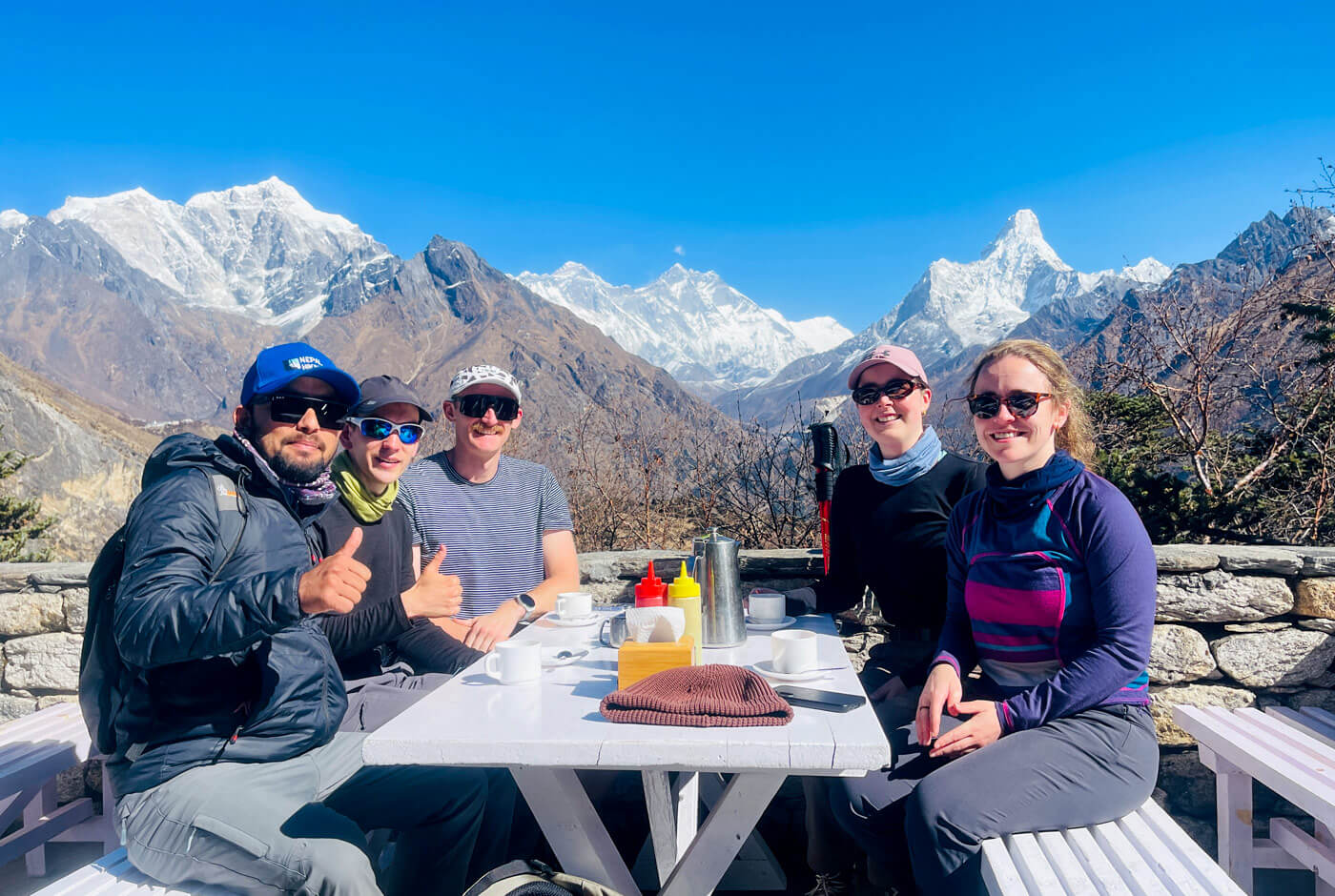
The Everest Base Camp trek is an immersive journey through varied terrain to the foothills of the tallest peak. Starting from Lukla, the trail passes through rhododendron forest, suspension bridges, monasteries, and local Sherpa settlements in Namche, Tingboche, Dingboche, and Lobuche.
The trail offers dramatic scenery that shifts from lush forests and rugged terrain to rushing glacial rivers (in lower regions) and an alpine desert surrounded by snow-covered peaks.
Trekkers can enjoy scenic mountain views throughout the trail during peak seasons, such as spring and autumn, as well as in winter, when the skies are clear. During the monsoon, the views can be obstructed by thick clouds and mist.
Some key highlights of the EBC trek include sunrise from Kala Patthar, the Khumbu Glacier, up-close insights into Sherpa culture, and views of Lhotse, Cho Oyu, and Ama Dablam.
Accommodation in Kilimanjaro and Everest
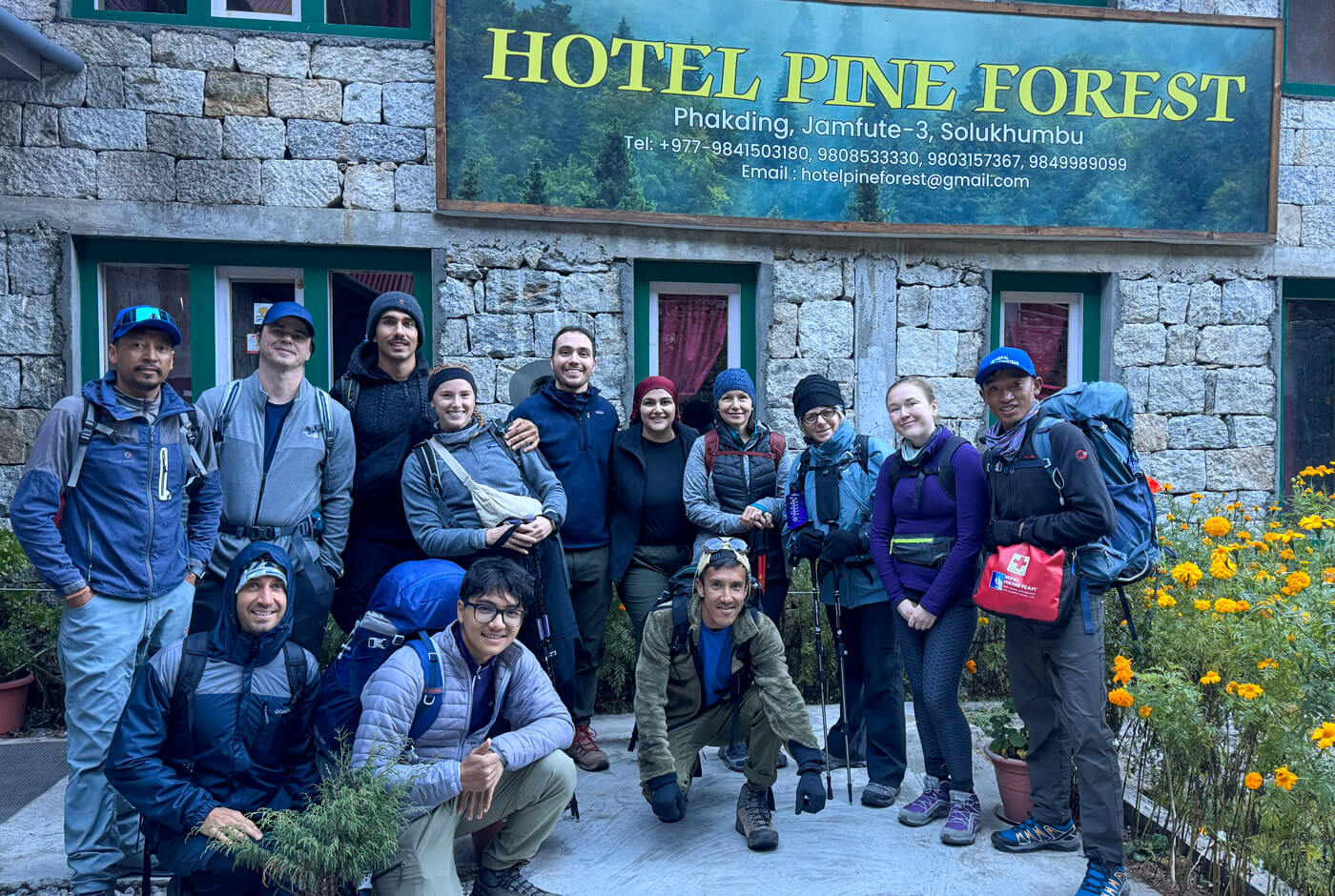
While Kilimanjaro is a camping-based trek, the Everest Base Camp is a teahouse (lodge-based) journey in the Himalayas. During the Mount Kilimanjaro expedition, trekkers sleep in 4-season tents or in specific mountain huts. The tents along the trail are set up by porters at pre-designated campsites and typically shared by 2 people. Trekkers can also book private tents for an extra charge.
On the Marangu route, huts are available, typically in shared bases and provide basic wooden bunks, thin mattresses, and blankets. This is the only route on the Kilimanjaro trail with a hut stay. Whereas the pre-climb stay in Arusha or Moshi is in lodges or hotels with comfortable rooms, beds, and amenities.
In addition, the accommodation during the Everest Base Camp trek is fully teahouse-based, providing comfortable beds, blankets, and warm meals. The teahouses are run by a local Sherpa family and offer twin-share rooms, shared bathrooms, hot showers, and Wi-Fi.
Trekkers can find teahouses with private rooms with attached bathrooms as well, while extra amenities like hot showers, Wi-Fi connections, boiled water, and charging facilities cost extra. Similarly, you can find bakeries and pubs in Namche Bazaar, the gateway to Mount Everest.
In short, accommodation facilities during the Mount Kilimanjaro and EBC treks are vastly different, though both offer unique experiences.
Is Mount Kilimanjaro Safer than Mount Everest?
In terms of peak, Mount Kilimanjaro is considered safer than Mount Everest due to a lower mortality rate (0.02% - 0.1%) compared to Everest, with 1%. On the other hand, the Everest Base Camp trek is considered easier and safer than Kilimanjaro when it comes to altitude sickness.
Risk of Altitude Sickness
Kilimanjaro is considered harder, with a higher risk of altitude sickness due to its rapid ascent, though EBC is more demanding because of the daily hiking distance.
The Kilimanjaro route climbs from 1,980 m to 5,895 m over a few days, increasing the risk of Altitude Mountain Sickness (AMS). About 50% or more trekkers experience AMS symptoms such as headaches, nausea, and fatigue during the trek.
Whereas the Everest trek affects an estimated 30-50% of trekkers with AMS. Nonetheless, the EBC route offers a safer, more gradual ascent, with acclimatisation stops at Namche and Dingboche, allowing trekkers to better adapt to high altitude.
Rescue Options
Rescue operations on Mount Kilimanjaro are mainly conducted by helicopter or by ground-based stretcher evacuation with porters and guides. Likewise, rescue options during the EBC trek are mainly by helicopter for severe cases and manual porter/horse transport to the lower altitudes.
In both treks, helicopter rescue remains the fastest and most reliable method for AMS, injuries, or other medical emergencies; however, it depends on weather conditions. Moreover, guides continuously monitor oxygen levels daily and recommend descending to safer elevations if the AMS symptoms persist, regardless of one's goals.
Success Rate
The EBC trek has a success rate of 85-90% due to its slow, steady acclimatisation, leading to low failure rates. Whereas the death rate is low and estimated at roughly 3-7 deaths per year out of 30-35,000 trekkers.
While Kilimanjaro has a success rate of 45-65% for shorter routes (like the Umbwe/Marangu), which improves to over 90% on a longer trek (like Lemosho) spanning 8-9 days. The death rate on Kilimanjaro is estimated at 0.03% to 0.1%, which is 3 to 10 fatalities out of 30,000 climbers.
Proper acclimatisation is crucial for trekkers to complete the EBC or Mt Kilimanjaro trek safely.
Also, with proper planning, fitness preparation, and a trusty guide, both treks can be completed safely.
Comparison Between Mount Kilimanjaro Vs Mount Everest Trek
Here is a table comparison between Mount Kilimanjaro vs Mount Everest Trek:
|
Features |
Mount Kilimanjaro |
Everest Base Camp (EBC) |
|
Highest Point (Altitude) |
5,895 m (Uhuru Peak) |
5,364 m at the base camp and 5,545 m at Kala Patthar |
|
Duration |
5-7 days (shorter, intense) |
12-16 days (gradual, longer) |
|
Difficulty |
High altitude, steep, faster pace |
Moderate to challenging, lower oxygen levels at higher altitudes |
|
Success Rate |
45-65 % (based on route) |
85-90% |
|
Accommodation |
Camping in tents except in Marangu |
Teahouses and lodges (lower region) |
|
Scenery |
Rainforest, Desert, Moorland, and Arctic |
Rhododendron forests, Sherpa villages, monasteries, and Himalayan peaks |
|
Primary Danger |
AMS due to rapid altitude gain |
Altitude sickness |
|
Focus |
Ascent to the peak, mental and physical endurance, and an immersive journey |
Cultural experience, Everest’s foothill, local foods, and ancient monasteries |
|
Technical skills |
Not required |
Prior trekking experience is helpful |
|
Best Time |
June-Oct and Jan-March |
Mar-May and Sept-Nov |
|
Cost |
$2,000-6,000 per person |
$1,500-3,500 per person |
|
Trailhead |
Northern Circuit Route: the northern slopes of Kilimanjaro |
Tenzing Hillary Airport, Lukla |
Final Thoughts: Which Trekking Should You Go For?
Both Mount Kilimanjaro and the Everest Base Camp trek are unique experiences with different elevations, durations, regions, cultures, and scenery. The EBC trek is a demanding Himalayan journey to the base of the highest peak, while Kilimanjaro is a challenging trek offering diverse landscapes in a short span.
Both of the treks require proper planning, fitness preparation, and maintaining a steady pace to avoid altitude sickness. You should choose the EBC trek if you're seeking an immersive experience through the mountains, whereas choose Mount Kilimanjaro if you want to experience diverse scenery in a short time.
We at Nepal Hiking Team provide safe, smooth, and well-organised Everest Base Camp Trek to travellers seeking an authentic Himalayan trekking experience. Our team offers licensed guides, reliable porters, carefully selected teahouses, and comprehensive safety kits. Our services are fully focused on the safety and comfort of trekkers, allowing them to enjoy the journey.
Post a Comment