9 Days
Check Our Risk-Free Booking Policy View Details

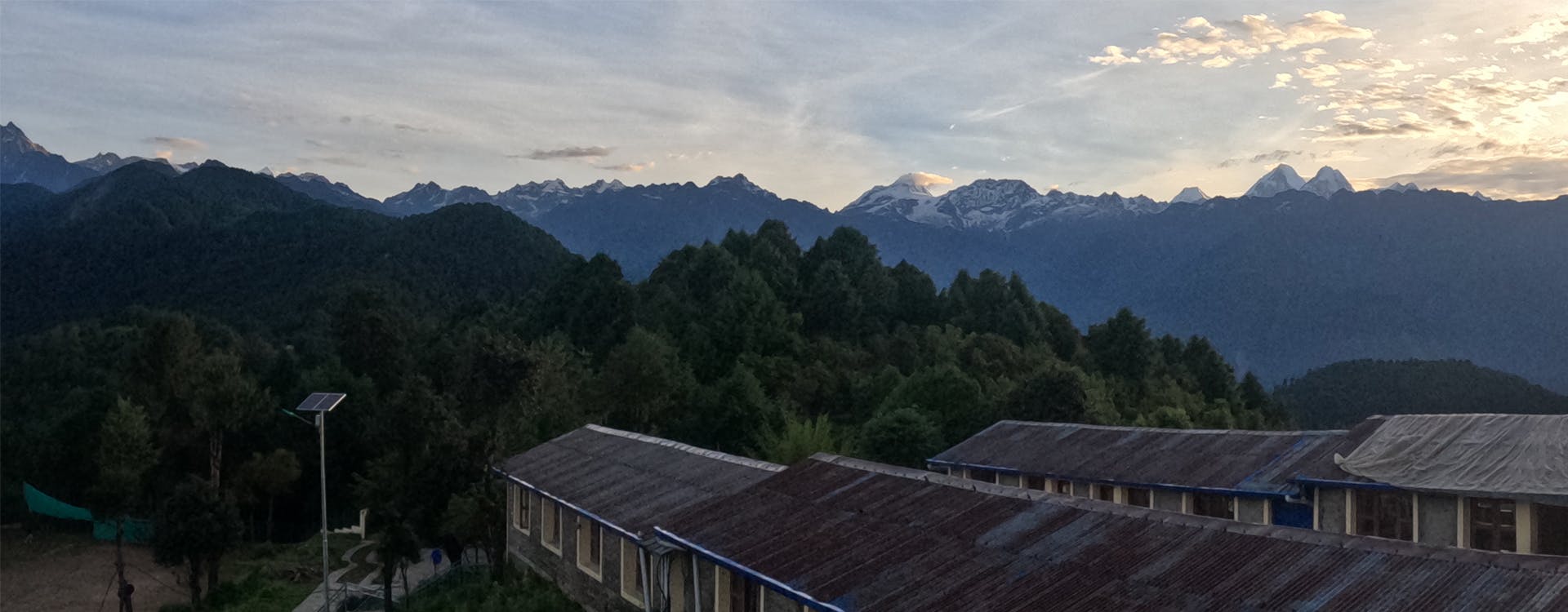
The Helambu Trek is one of the short and rewarding Himalayan trekking experiences close to Kathmandu. This trek is generally less popular than many other routes, but offers an equally peaceful, nature-rich escape, making it a perfect alternative to the Langtang region treks. The trek goes through green valleys and traditional villages, and offers beautiful Himalayan views.
The trek starts via Sundarijal in Shivapuri–Nagarjun National Park, a wildlife-rich area with rhododendron, pine, oak, and bamboo groves. As you move along the trail, you’ll meet Hyolmo, Tamang, and Sherpa communities where you can immerse yourself in authentic traditional village life and cultural trekking experiences.
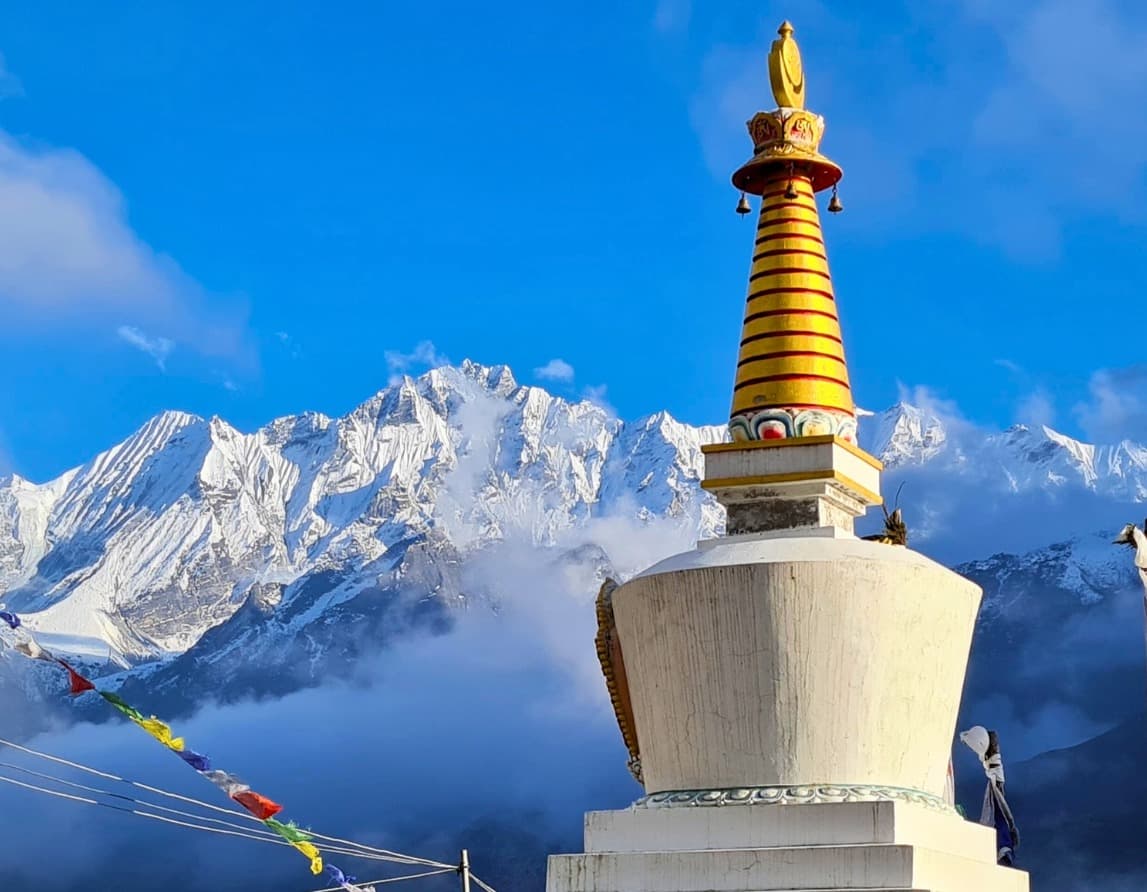
Throughout the trek, travellers can visit long-standing Buddhist monasteries across the Helambu region and feel the area’s spiritual atmosphere. Likewise, trekkers can witness distant mountain views of the Langtang, Dorje Lhakpa, Gaurishankar, and Jugal Himal ranges.
One of the trek’s highlights is the panoramic viewpoint Ama Yangri (3,771 m). This is also the highest point on the route and holds spiritual value for the local Hyolmo community.
The overall trek is considered easy to moderate, suitable for both beginners and experienced trekkers with basic fitness, preparation, and a well-organized itinerary. The best time for the Helambu Trek is during spring (March to May) and autumn (Sept to Nov).
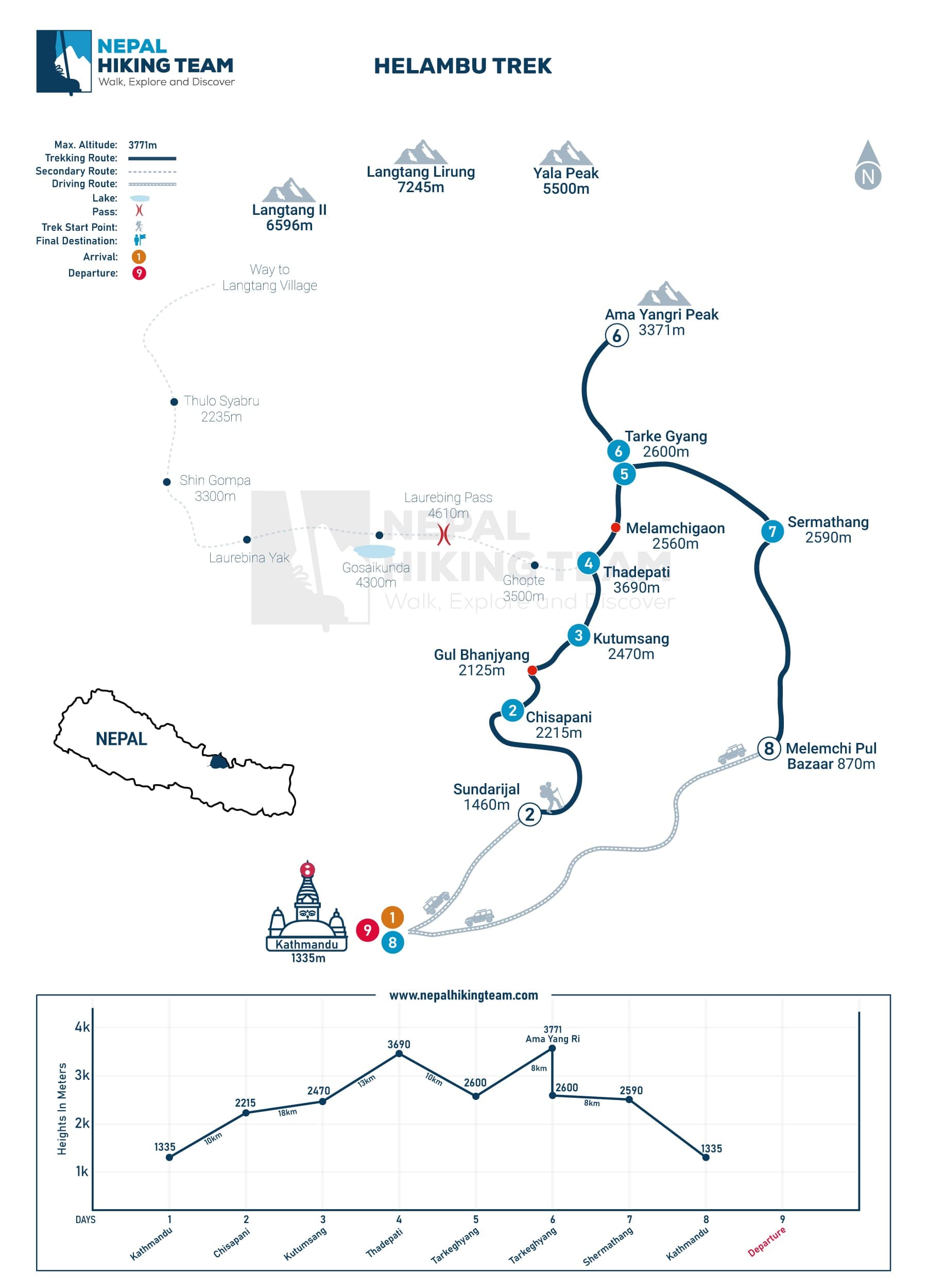
The Helambu Trek starts with a drive from Kathmandu to Sundarijal by a private vehicle. From there, your main trailhead begins on foot. You will quickly enter Shivapuri–Nagarjun National Park, leaving the city behind for lush forest, waterfalls, and the Tamang village of Mulkharka. The day’s walk climbs to Chisapani, where an early sunrise can reward you with panoramic views of the Langtang range.
The next day, the trail descends and climbs across meadows and ridges toward Kutumsang, passing Pathi Bhanjyang and Gul Bhanjyang and a low pass near 2,620 m. From Kutumsang, you’ll enjoy close views of Dorje Lhakpa and other peaks before continuing higher toward the ridge.
En route to Thadepati/Tharepati, trekkers will pass Yurin Danda and walk through the fir and rhododendron forests with panoramic mountain views. From Thadepati, the route descends to Melamchi Gaon and gradually climbs up to Tarkeghyang, the cultural and spiritual heart of Helambu.
From Tarkeghyang, the trail moves toward Ama Yangri viewpoint at 3,771 m, from where we can enjoy panoramic views of Langtang Lirung, Ganesh Himal, Dorje Lakpa, Gaurishankar, and Jugal Himal. Afterwards, the trail descends toward Shermathang, a popular place for apple orchards, authentic stone houses, and traditional Buddhist culture.
On the final day, we will cross green meadows, farmlands, and rice fields, down to Melamchi Pul Bazaar, from where we will drive back to Kathmandu, completing our 9-day Helambu Trek.
Besides the Helambu Trek, Nepal Hiking Team runs equally immersive and culturally rich trekking experiences in the Langtang Valley.
A short and immersive trek in the Annapurna region offering stunning views of Machhapuchhre and Annapurna South.
Shorter version of the classic ABC Trek, perfect for trekkers seeking mountain views on a tight schedule.
Witness panoramic views of Dhaulagiri, Annapurna, Nilgiri, Machhapuchhre, and Hiuchuli from the Khopra Danda viewpoint at 3,660 m.
Booking the Helambu Trek with an experienced and local trekking expert such as Nepal Hiking Team ensures a smooth, safe, and well-organized trekking experience. Our itineraries are prepared keeping safe pacing, comfort, and daily walking hours in mind.
We organize our trek packages from small groups of 2 up to 10 trekkers, allowing our guides to provide proper support and attention throughout the journey. In addition, our professionally trained guides monitor your health, provide medical services, and even organize emergency rescue operations when necessary.
Nepal Hiking Team offers transparent pricing, comfortable accommodation, transportation, and handles necessary permit processing, all while balancing cultural immersion and authentic Himalayan trekking experiences in the Helambu region.
On your arrival day at Tribhuvan International Airport, a representative from the Nepal Hiking Team will meet you and welcome you.
After that, they will transfer you to the hotel, assist with the check-in procedure, and after resting/relaxing for a while, we will hold a brief pre-trek meeting. During the meeting, we will introduce you to your guide, provide you with the necessary trekking gear, and discuss the trail conditions and logistics.
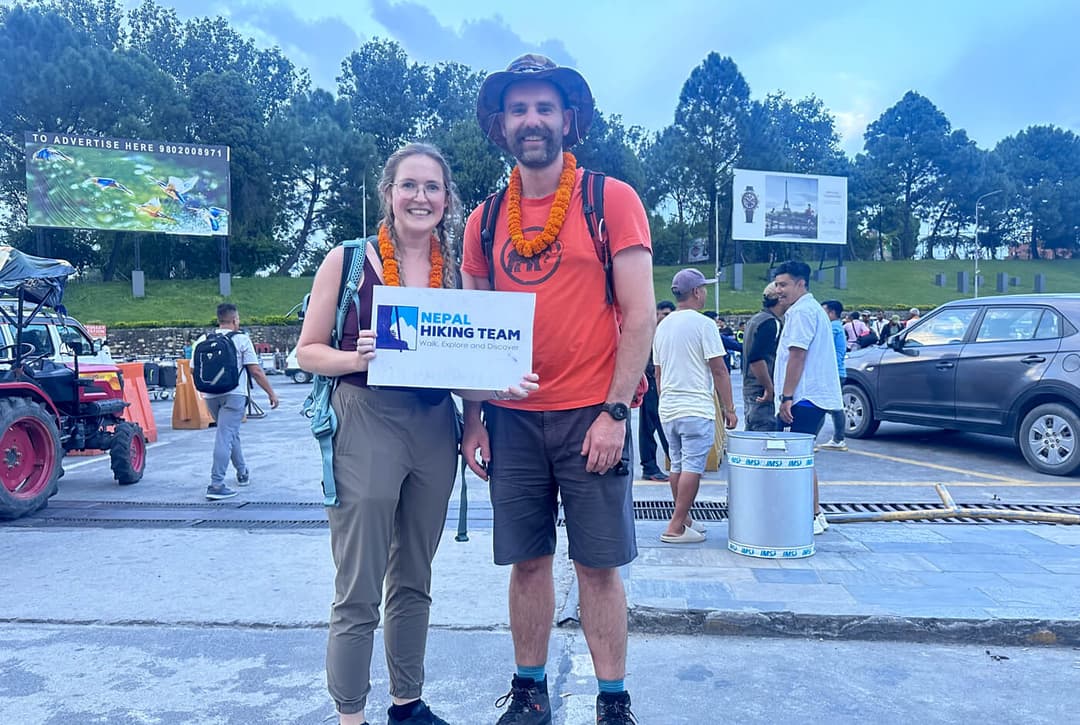
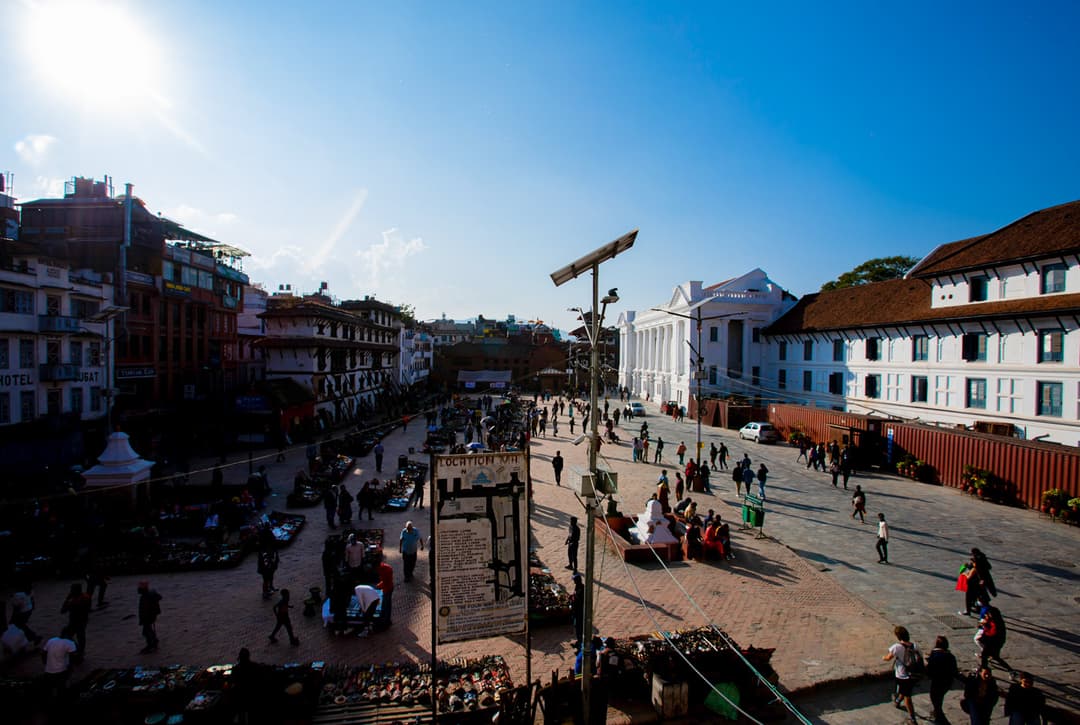
After a hearty breakfast, you’ll leave for Sundarijal in a private vehicle. Sundarijal is our official trailhead, from where the route traverses a series of steep stone staircases, forested areas, and waterfalls.
Through this route, we will enter the Shivapuri Nagarjun National Park, a formally protected watershed and wildlife reserve. Continuing, trekkers will come across the first settlement, Mulkharka, mostly inhabited by the Tamang and Gurung communities. The village is popular as a one-day hiking and picnic spot near the Kathmandu Valley.
Continuing past Mulkharka, you’ll traverse oak and rhododendron forest and stone pathways with gentle ascents. From Mulkharka to Chisapani, the hike gains about 300 m in altitude, offering views of the Langtang, Ganesh Himal, and Gaurishankhar mountain ranges.
After enjoying morning views of the Langtang Himal range from Chisapani, we will head towards Kutumsang. We will pass through scenic meadows and farmlands, descend towards Pathi Bhanjyang, and eventually reach Gul Bhanjyang.
From Gul Bhanjyang, we will walk towards the Ridge at 2,600 m, making it a more demanding portion of the day. The final stretch from the ridge toward Kutumsang starts to feel more mountainous with its changing mountain scenery.
Today, we will ascend from Kutumsang towards Thadepati at 3,650 m, passing through dense rhododendron, oak, and fir forests. Likewise, the trail features stone steps, rocky paths, and uneven terrain, passing Yurin Danda and Mangengoth before reaching the higher altitude.
As you ascend higher, the forest gradually gives way to alpine meadows and ridges, offering views of Jugal Himal, Dorje Lakpa, and Langtang Himalayan ranges. The overall trail condition from Kutumsang to Thadepati is generally well-established but features steep climbs, rocky and some slippery sections.
From Thadepati, the route to Tarkeghyang begins with views of the Langtang and Jugal Himal ranges. The trail then gradually descends through the forests of rhododendron, pine, and oak, and passes through Melamchi gaon. This is a traditional Sherpa/Hyolmo village featuring Buddhist monasteries, terraced fields, and mountain scenery.
After crossing the Melamchi Khola, the route climbs toward Tarkeghyang, one of the largest settlements in Helambu. The village has traditional stone houses, and the people have Hyolmo heritage and follow Buddhist culture.
Along the route, trekkers can also spot horses grazing in the pastures, small streams, chortens, prayer flags, and local settlements. This also reflects the distinctive Buddhist culture of the Helambu region.
Today is a challenging yet rewarding day of the Helambu Trek. From Tarkeghyang, the route steadily climbs to Ama Yangri viewpoint at 3,771 m (12,372 ft) with a total elevation gain of 1,170 m (3,840 ft).
The initial part of the trail passes through dense pine and oak forests, rhododendron groves, prayer flags, chortens, and mani walls. As we climb higher, the forests become thinner and give way to rocky terrain and alpine grassland.
The final stretch to the Ama Yangri viewpoint can feel steeper and more rocky, requiring stable footing and a steady pace. On clear days, trekkers can witness Langtang Lirung, Dorje Lakpa, Jugal Himal, Gaurishankar, Ganesh Himal, Shishapangma, and distant views of Mount Everest.
You can visit the Ama Yangri Zangdo Palri Gumba, which is nestled at the top of the hill. The monastery holds great spiritual significance among the locals, the Hyolmo community. After enjoying mountain views, we will descend back to Tarkeghyang.
After having breakfast, we will head towards Shermathang, crossing lush pine, fir, and bamboo forests, small settlements, and open hillsides. Along the way, we will pass through a traditional settlement called Ghangyul, reflecting the deep Buddhist and Hyolmo heritage of the region.
Today’s hike can feel easier and more relaxed, passing through peaceful forests, terraced farmland, and occasional waterfalls along the way. Upon arriving in Shermathang, trekkers can witness panoramic views of Langtang, Dorje Lakpa, Ganesh Himal, Jugal Himal, and parts of the Rolwaling range.
The trail from Shermathang to Melamchi Pul Bazaar gradually descends through traditional villages, terraced farmland, meadows, and lush green forests. Along the route, trekkers will pass local settlements such as Nigale, Kakani, Gyalsha, and Raithani Gyang.
One of the highlights of this day is the smooth change in landscape and vegetation. As we continue our descent, the mountain scenery gradually gives way to warmer, subtropical surroundings of the Melamchi river basin.
Upon arriving in Melamchi Pul Bazaar, we will drive back to Kathmandu on a private vehicle, marking the end of the Helambu Trek’s walking portion. The drive begins through the Melamchi Valley and traverses rural settlements, terraced farmland, rivers, and hills. We will arrive in Kathmandu, passing nearby towns of Dhulikhel, Banepa, and Bhaktapur, renowned for their Newari architecture and history.
Today marks the end of your 9-day Helambu Trek. Our representative will pick you up from the hotel and transfer you to the airport three hours prior, depending on your flight timing.
This gives you enough time to clear security, baggage, and the immigration process without last-minute hassle. As you leave Nepal, you will carry thousands of photographs and memories of the Helambu region, its rich Hyolmo heritage, and Buddhist culture.
With over a decade of experience, Nepal Hiking Team combines local expertise, professionally trained guides, and carefully planned itineraries to make your Helambu Trek smooth, safe, and comfortable. Our team ensures a smooth journey as you experience the rich Tamang and Sherpa culture, Buddhist heritage, mountain landscapes, and community-based hospitality of Helambu.
The best time for the Helambu Trek is during spring (March to May) and autumn (September to November). During these seasons, the trekking conditions are favorable, with clear mountain views, stable routes, and pleasant overall temperatures. You can also complete the trek during the month of late January to early Feb and celebrate Sonam Losar, one of the Tamang people’s festivals.
The Helambu Trek is a great alternative to Langtang for visitors seeking shorter, quieter, and less crowded trails. Although both trekking trails lie north of Kathmandu and offer deep Tamang, Sherpa, and Buddhist influences, each of them offers unique experiences.
The Helambu region is quite popular for its Sherpa and Hyolmo cultural heritage and combines traditional villages, monasteries, local culture, and mountain views without requiring high altitude or a longer trek. Similarly, the trail passes through terraced farmland, lush forests, rhododendron-covered hills, and high ridges, rather than following one continuous Himalayan valley.
Overall, its accessibility, manageable elevations, moderate duration, and excellent views of Ama Yangri, Langtang Lirung, Ganesh Himal, and others make Helambu a practical choice for trekkers seeking a Himalayan trekking experience without a more demanding route.
One of the key highlights of the Helambu trek is staying in community-based and locally run accommodations. Rather than relying on standardized teahouses and trekking lodges, the Helambu trail offers homestay-style accommodation and community-run guesthouses.
This allows trekkers to experience the warm hospitality and stay within or closely connected to the local lifestyle. In addition, this accommodation style offers a more personal and culturally immersive experience with an opportunity to interact directly with local families, Hyolmo and Sherpa traditions, local food, and everyday village life.
Overall, Helambu’s initiation of small guesthouses, homestays, and community-oriented accommodation offers a more intimate village life as well as a Himalayan trekking experience.
The 9-day Helambu Trek is considered easy to moderate with low risk of altitude-related difficulties. Most of the trek remains at a manageable elevation, i.e., around 3,500-3,900 m, with low technical difficulties on the trail.
The route features continuous ascents and descents with an average of 5 to 7 walking hours per day. However, it is easily manageable even for beginners with basic fitness and for hikers or those who regularly exercise.
Compared to other high-altitude treks, the Helambu trek is easier, more flexible, and peaceful, with a shorter itinerary. It makes it a suitable choice for trekkers seeking for a rewarding experience without any extremely demanding high altitude expedition.
Read our genuine feedback from past travelers with Nepal Hiking Team sourced from TripAdvisor, Google, Facebook, and Trustpilot.
I highly recommend the Nepal Hiking Team for anyone planning to trek in Nepal. My spouse and I had a fantastic time on our trek and greatly credit our positive experience to the thought and care put into it by Nepal Hiking Team in coming up with a personalized plan that would enable us to succeed.
Every detail was considered to match us based on our abilities and interests. We also could not have felt more cared for minute to minute by the team that supported us from the minute we arrived in Kathmandu until our departure.
Our guide, Nim, was amazing -- so careful, thoughtful, warm, and supportive. And our porters, Sabin and Ganesh, were delightful. They were all unbelievably generous in terms of how much they worked to ensure we were comfortable and prepared. They thought of every detail along the way.
- Guided By Nim Dahal
Our adventure with the Nepal Hiking Team was nothing short of remarkable! We embarked on an exhilarating trek through the Langtang Valley, guided by our expert, Ganga. Boasting an impressive 23 years of experience, Ganga's deep understanding of the terrain was unmatched.
He expertly navigated the balance between adventure and safety, always prioritizing our well-being and ensuring our safety. Beyond his professional skills, Ganga's warm and approachable personality enhanced our journey significantly. We developed a strong bond with him, enriching our trekking experience immensely.
We eagerly anticipate our next adventure and look forward to trekking with Ganga again!

I hiked Mardi Himal, Annapurna Base Camp, Annapurna Circuit, and Langtang Helambu all with Nepal Hiking Team in the span of November and December 2023. Honestly, I can safely say that I couldn’t have thought anything being better than this. My guide, (Rajesh), and porters (Awjeey, Prabin, and Dipesh) were friendly, kind and also deeply knowledgeable about the Himalayas and always ready to lend a hand whenever needed.
Every part of the service exceeded expectations. Travelling between Kathmandu and the trekking ends were smooth and hassle-free. The meals along the route were appealing, and the accommodations were the best you could find in each location. If I ever trek in Nepal again, there’s no doubt I’ll be choosing Nepal Hiking Team.
And then, of course, there were the views. Poon Hill during Annapurna Base Camp, Mardi Himal Viewpoint, Thorong La Pass, and Gosaikunda Lake—each view alone would make a trek absolute wondrous. But to experience them all in one trip, along with the incredible scenery every time you glance around, makes me wonder why I’d choose to hike anywhere other than Nepal.
I’m already looking forward to my next trip to Nepal and can’t wait to trek with Nepal Hiking Team again and again!

We hiked the Helambu Trek in May. Ganga at Nepal Hiking Team organized everything and personally facilitated all of our transfers and introduced us to our guide and porter for the week-long trip. Everything went smoothly and I definitely recommend Ganga's company to book your Nepal trip.
The Helambu trek itself is relatively low-altitude but is fairly strenuous (lots of ups and downs!). You really earn that plate of dal bhat at the end of the day. Scenery is mostly green hillsides with the occasional view of the peaks. The people of this area are genuinely friendly and seem really pleased to have tourists starting to trek in the region after the devastating earthquake.
We trekked at the end of May and caught the very beginning of the monsoon season, which meant that it rained in the afternoon and limited visibility. But as we started early every morning, we never had to abbreviate or delay parts of the trip. We had only a brief time in Kathmandu but were able to make the most of it thanks to an excellent tour of several cultural and religious sites of significance.
We had a great time in Nepal and would not hesitate to use Nepal Hiking Team's services again. Thanks Ganga, Bheem, Prim, and Kumar!
After ABC and Jiri-EBC trekking with NHT, I just completed my 3rd trekking trip in Nepal with the help of Nepal Hiking Team. Ganga was still the same: reliable, sensible, swiftly responding to my enquiry. He waited patiently for my arrival at airport near midnight. He also arranged a car to pick us up from Melamchi on my last day to make sure I wouldn't miss my flight.
Nepal Hiking Team has doing very well and Ganga was very busy, but he still managed to see me off at airport in person. My guide Bhakta and porter Ram were great - I wouldn't have returned in one piece without their assistance. This time I combined four short treks into one: Tamang Heritage - the Classic Lang Tang - Gosaidkunda - Helambu.
From my memory, I walked across the highest number of landslide sections on this route compared with ABC and EBC. At quite a few locations, Bhakta and Ram would have to assist me with the crossing. Tamang Heritage and Helambu (Ghangyul route) areas were rather quiet and less walked - even Bhakta hasn't trekked the entire routes himself but the two of them were very good to get guidance from the locals. It was fun to trek through some local routes and to see how the locals live. Thanks very much Ganga, Bhakta, Ram and NHT!
Nepal Hiking Team has been leading the Helambu Trek with well-planned itineraries, decade-long experience, and professional guides. We ensure each trek is enjoyable, smooth, and adventurous, keeping safety and comfortable pacing in mind.
Whether you’re a solo trekker or a group of 10, our team will handle logistics such as accommodation, transportation, a guide, a porter, and permits, allowing you to focus on the journey.
NHT has a strong bond with the local communities in the Helambu region and works closely with the guest house owners. By booking the Helambu Trek with us, you directly support local guides, community-run guest houses, and the community itself in their ongoing efforts to protect the authentic trekking experience, lifestyle, culture, and traditions.
During the 9-day Helambu Trek, we provide essential trekking gear like a duffel bag, a down jacket, and a sleeping bag rated up to -15°C for the duration of the trek. Likewise, we also provide a detailed Langtang region map, a complimentary NHT T-shirt, and a cap.
While in Kathmandu, trekkers will stay at a 3-star category hotel such as Woodapple Hotel & Spa, which is included in the cost of our Helambu package. Breakfast is also included in the package.
Yes, we can customize our itineraries to suit your preferences, service level, and overall comfort throughout the journey. If our standard 9-day Helambu Trek itinerary does not meet your needs, we can design an itinerary based on your timing and specifications.
To book the Helambu Trek, go to the booking page and complete our booking form with your personal information and travel details. After that, make a 20% deposit to confirm your spot. Once our team receives the form and the deposit amount, we will secure a spot for you for the scheduled departure date.
The Helambu Trail is rated easy to moderate, making it suitable for both beginners and experienced trekkers. The highest point reached is around 3,771 m at Ama Yangri viewpoint, keeping elevation gain relatively low compared to other high-altitude treks in the Himalayas.
The daily walking duration per day ranges from 4 to 6 hours, covering approximately 10 to 15 km on average. For instance, the distance from Sundarijal to Chisapani is about 10 km and takes around 4-5 hours, whereas the last-day trek from Shermathang to Melamchi Pul Bazaar is about 10 to 12 km, followed by a drive back to Kathmandu covering 40 km total distance.
The best time for the Helambu Trek is during spring (March to May) and autumn (October to November). During these seasons, the weather is stable, with safe trail conditions and peak mountain views.
As the route doesn’t go over 4,000 m, the risk of altitude sickness on the Helambu Trek is relatively low. However, it is crucial to stay hydrated, maintain a steady pace, and follow your guide’s advice to lower the risk.
Trekkers should bring personal trekking equipment such as sturdy, waterproof trekking boots, comfortable and layered clothes, a fleece jacket, a warm hat, gloves, a waterproof outer shell, a headlamp, and a reusable water bottle.
During the trek, guests will stay at the community-run guest houses that provide comfortable beds, clean rooms, and warm meals. The rooms are usually shared between two trekkers.
Mobile network in the Helambu region can be limited, while Wi-Fi can be available even at higher elevations for an extra charge. Larger and popular villages such as Tarkeghyang, Shermathang, and Melamchi Bazaar have good mobile network and Wi-Fi connections.
Natural drinking water sources are easily available along the trail, so trekkers can use water purification tablets to filter the natural spring water. In addition, you can use a reusable filtered water bottle and purchase boiled drinking water from the guest houses at a certain cost.
Tipping culture for guides and porters is not mandatory but customary to show appreciation for their hard work and services throughout the journey. Trekkers can tip the staff members with an amount that reflects gratitude for their effort and hard work during the trip