

The Gokyo Lakes are a series of high-altitude glacial and oligotrophic lakes in Nepal's Sagarmatha National Park, sitting at elevations of 4,700 to 5,000 meters (15,400 to 16,400 feet) in the Solukhumbu District.
Indulge in the experience of standing and relaxing at the shore of the world’s highest freshwater lakes. Here’s everything you need to know about Gokyo Lake.
Gokyo Lakes comprises six glacial lakes: Gokyo Cho, aka Dudh Pokhari, Phonak Cho, Gyazumpa Cho, Tanjung Cho, and Ngojumba Cho.
With Gokyo Cho, aka Dudh Pokhara, the main one among the six lakes, it is the world’s highest freshwater lake system, located at an altitude of 4,700 - 5,000 m above sea level in the Sagarmatha National Park, home to Mount Everest in Nepal.
Trekkers often visit Gokyo Lakes as a side trip on the famous Mount Everest Base Camp trek. Regardless, we have several other Gokyo Lakes packages that will give you the ultimate Everest experience if you want to avoid the busier Everest Base Camp Trek route.
Gokyo Lakes Nepal Key Facts
- Location: Solukhumbu District, inside Sagarmatha National Park.
- Elevation: Situated between 4,700 and 5,000 meters (15,400–16,400 feet) above sea level.
- Glacier: Fed by the Ngozumpa Glacier, the longest glacier in the Himalayas.
- Total Number: Composed of six main lakes.
- Primary Lake: Gokyo Cho (Dudh Pokhari), covering 42.9 hectares next to Gokyo Village.Largest & Deepest: Thonak Cho, reaching a maximum depth of 62.4 meters.
- Status: Designated as a Ramsar wetland site of international importance since 2007.
- Famous Viewpoint: Gokyo Ri (5,357 meters) sits right above the third lake, offering panoramic views of Everest, Lhotse, Makalu, and Cho Oyu.
- Best Time to Visit: Autumn (September to November) and Spring (March to May).
- Difficulty: Rated as challenging due to extreme high altitude and steep ascents.
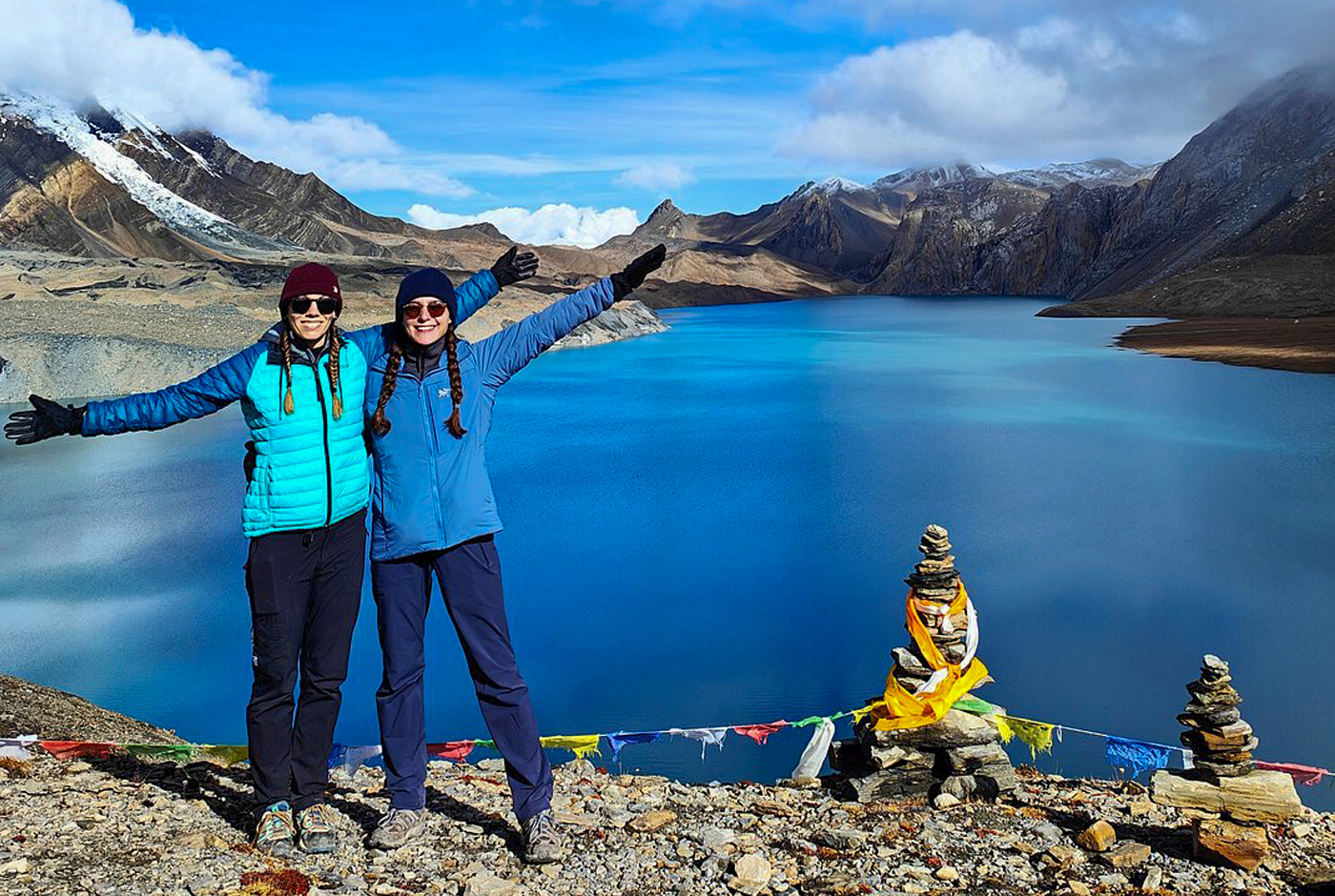
Gokyo Lakes Highlights. Why is it popular?
- The major attraction of Gokyo Lakes is relaxing alongside the world’s highest freshwater lake (the highest lake of Everest) system while enjoying the ultimate Everest experience at 5000 m.
- The Gokyo Lakes also holds great religious significance and are considered sacred by both Hindus and Buddhists.
- During the Janai Purnima festival, people from all around the country visit Gokyo Lakes to take a holy bath.
- Another core attraction of this trek is the mesmerizing views of the glorious mountains such as Mt. Lhotse, Mt. Makalu, Mt. Cho Oyu, etc.
- The hike through the scenic forests of Sagarmatha National Park will allow you to explore the wildlife habitats, birds, and natural Vegetation.
- Residing at the heart of the Khumbu region, the trek to Gokyo Lake will allow you to learn, witness, and experience the unique culture and traditions of different ethnic groups, mainly sherpas.
- Lastly, witnessing the magical sunrise over Gokyo Ri has to be one of the main highlights of this trek.

Why must you go on an Everest Gokyo Lake Trek?
Well, there is no reason why one should not visit Gokyo Lake. It is one of the beautiful places in the Khumbu region but is less visited. Although the place does get fewer visitors, that does not mean it lacks any sense of beauty. The place offers a majestically beautiful setting with its tranquil backdrop and a great chance to indulge in the infamous Sherpa culture. Home of the famous Sherpa tribes known for their impressive records of summiting the world's highest peaks, this trek is a remarkable opportunity to learn about their excellent cultural background. Overall, in the coming section, we highlight the best features of the Gokyo Lake Trek, so stay tuned and read further:
Best features of the Trek
A memorable adventure among big mountains
The Gokyo Lake trek is for lovers of adventure. The hike climbs to the glacial Gokyo Lake, sitting amid big mountains. Famous mountains of the world rise in front of you in this valley - Mt. Everest, Mt. Cho Oyu, Mt. Lhotse, Mt. Makalu, Mt. Nuptse, and many more. You stay in the shadow of the mighty snow peaks in the world.
Many treks in Nepal bring you close to big mountains, but Gokyo Lake Trek, without any questions, offers the most scenic and thrilling experience.
A remote trekking trail
Gokyo Lake Trek goes through a remote trekking trail in the Everest region. Thus, one can consider the trek route to be highly remote as well. There is no proper human settlement at this altitude. And you will find very few trekking groups on this trail. When seen in comparison to a lot of other, unfortunately crowded trails, this solitude is a blessing.
The Gokyo Valley's pristine elegance
The Gokyo Lakes' dazzling, translucent blue and green waters are unforgettable. But spending a glorious day at the small habitation of Gokyo is equally splendid. There are not many houses, and all homes are in some way like a teahouse. Thus, the settlement here exists only for commercial reasons. Setting a few hours away from your long journey to chat with the locals is completely worthwhile too. Similarly, there are a few small cafes and bakeries where freshly made goods are made. Thus, travelers can find themselves in a lovely corner and enjoy newly made baked goods and spend their time enjoying the scenery surrounding them.
Six sacred pools of Gokyo Lakes
There are six spectacular lakes situated at an altitude ranging between 4700m and 5000m, making them some of the world's highest freshwater lakes. Both Hindus and Buddhists believe that Lake Gokyo is sacred. Around 500 Hindus bathe in the lake during the Janai Purnima festival, usually held in August. The valley is best known for its six emerald blue lakes, namely, Longabanga Tso, Tanjung Tso (4,720m), Gokyo Tso, Donagh (4,870m), Ngozumpa (4,990m), and Gyazumpa (5,150m). The sixth lake is also known as Cho Oyu First Base Camp.
Hike to Gokyo Ri
Standing at the height of 5357 meters, Gokyo Ri is a small peak in Gokyo Valley. This peak overlooks the Gokyo village, Gokyo Lakes, and Ngozumpa glacier, and the mighty Himalayas. The ascent of Gokyo Ri is steep and challenging on some level too. Nevertheless, from the peak's summit, you will see a much grander view of Everest massif. The top of the ridge shows the panoramic view of eight thousand such as Everest, Makalu, Lhotse, Cho Oyu, and other majestic peaks.
Explore Ngozumpa glacier
Take your precious time to explore the captivating Ngozumpa Glacier- the longest glacier in the Himalayas. It is below the sixth highest mountain in the world- Cho Oyu. The glacier is 36 kilometers long and is a large persistent body of ice. It flows slowly due to stresses induced by its weight.
Gokyo Lake ALtitude
Gokyo Lake, a series of freshwater lakes in the Everest region of Nepal, sits at an altitude ranging from 4,700 to 5,000 meters (approximately 15,420 to 16,404 feet). Specifically, the largest lake in the group, Gokyo Cho (also known as Dudh Pokhari), is at the higher end of that range, around 5,000 meters.
How to reach Gokyo Lakes from Kathmandu?
Your first step towards the mystical Gokyo lakes is the flight to Lukla. You will see the beautiful views of the Himalayas, hills, and the Lukla village in one picture. This flight will be an adventure for you as the runway of Lukla airport is considered one of the most dangerous runways in the world.
Your trek starts after your flight as you walk towards the Namche Bazar, the popular tourist hub while getting past the Phakding and witnessing the glorious mountains such as Mt Everest, Mt Thamserku, Mt Ama Dablam, and others in your rear sight. After walking for several days through the Dole, Machhermo, and others, you will reach your final destination, Gokyo Village.
The Gokyo Village is one of the highest settlement areas in the whole world, located at the height of 4,750 m above sea level in the lap of the Himalayas. You can encounter all six lakes from Gokyo Village. You will witness beautiful scenic landscapes, walk through the banks of several pristine rivers, and see wildlife along the Gokyo Village trail.
Additionally, if you still have some energy left after hiking to Gokyo Village, you should hike up to Gokyo Ri. Situated at a height of 5,357 m, it offers the view of the four highest peaks in the world- Mount Everest, Mount Lhotse, Mount Makalu, and lastly, Mt Cho Oyu.
Exact Location of Gokyo Lake
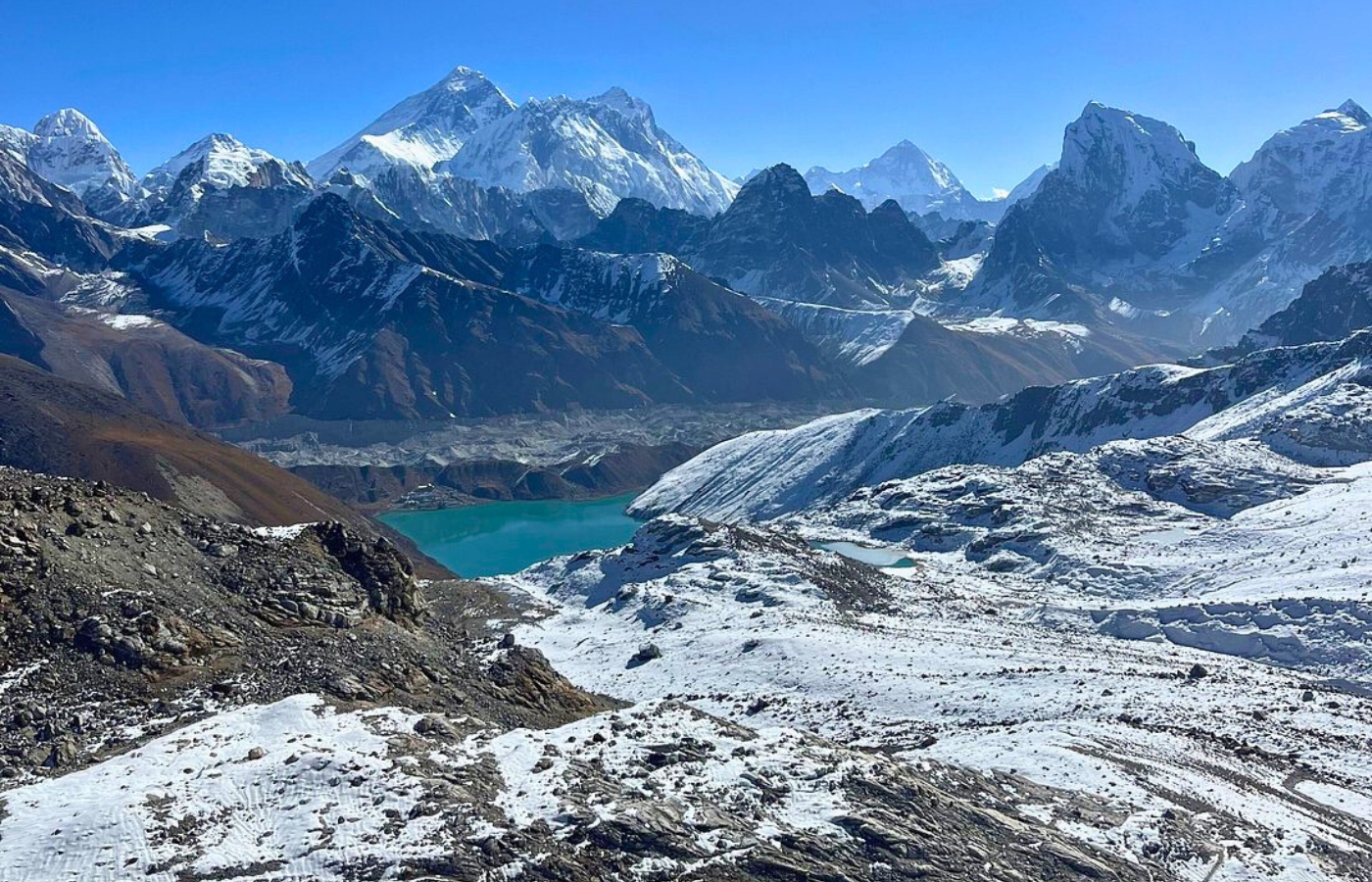
Gokyo Lake sits high in the Himalayas, quiet and cold, reflecting the sky like a polished stone. It’s part of a chain of six lakes, the highest freshwater system on Earth. The journey starts in Kathmandu. A small plane fights the wind to land in Lukla.
From there, the path winds up through Namche Bazaar, past rushing rivers and ancient trails. Days of climbing bring you to Gokyo Valley, where the lake waits, deep and still. Everest looms to the east, but from Gokyo Ri, the whole world of giants—Lhotse, Makalu, Cho Oyu—rises into view. The lake belongs to the Mahalangur Himal, a kingdom of ice and rock.
It rests in Solu-Khumbu, where prayer flags snap in the wind, and yaks move like shadows against the snow. At 27.9575° N, 86.6926° E, the water is sacred, untouched, and cold as the breath of the mountains.
Nepal Gokyo Lake Trek Itineray and Map
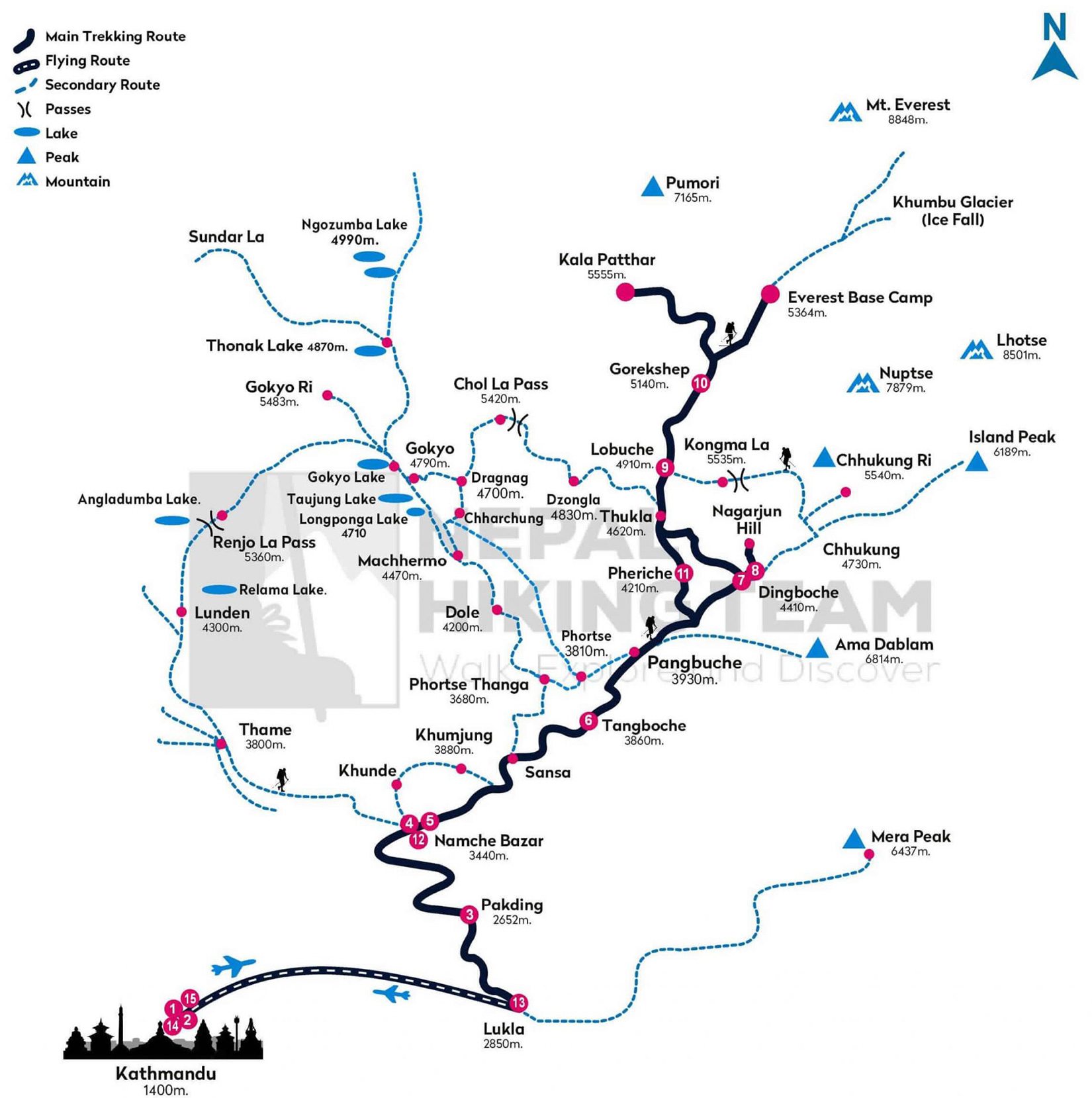
Detailed Itinerary of Gokyo Lakes Trek
- Day 01: Fly to Lukla and trek to Phakding (2652m/8699ft) Duration: 3 hours
- Day 02: Phakding to Namche Bazaar (3440m/11283ft) Duration: 6 hours, Distance: 10-12 km
- Day 03: Hike to Everest View Hotel (3,880m), then return.Distance: 3-4 km, Duration 3-4 hrs.
- Day 04: Trek from Namche to Dhole (4200m/13776ft), Distance: 11km, Duration: 5 hrs
- Day 05: Trek from Dole to Machhermo (4400m/14432ft), Distance: 6 km Duration: 5 hrs
- Day 06: Trek from Machhermo to Gokyo Lake (4,700m/15,416ft). Distance: 7km, Duration: 4 hrs
- Day 07: Hike to Gokyo Ri (5,360m/17,880ft) and return. Distance: 5km, Duration: 4 hours
- Day 08: Trek back from Gokyo to Dole (4,200m/13,776ft). Distance: 12km, Duration: 6 hours
- Day 09: Trek back from Dole to Namche Bazaar. Distance: 11km, Duration: 5 hours
- Day 10: Trek back from Namche to Lukla (2,880m). Distance: 19km, Duration: 7 hours
- Day 11: Fly from Lukla To kathmandu
Everest Gokyo Lake Trek - 2027
When is the best time to visit Gokyo Lakes?
Like most treks in Nepal, the best time to visit Gokyo Lakes through the lap of the Himalayas are Spring (March-May) and Autumn (September-November).
The weather is likely to be clear during these months, with the daytime temperature warm, allowing you to have the best trekking experience. You can even witness the national flower of Nepal- the Rhododendron in full bloom during the spring months.
It is possible to trek to Gokyo Lake in the summer or winter season. Still, it is most likely to rain during the summer, and the trekking trail will likely be foggy during the winter months, increasing the risk and complex conditions. Considering these points, you may not even get to see clear views.
Overall, the Gokyo Lake Trek will grant a life-changing experience regardless of which season you visit.
Difficulty Level of Gokyo Lake Trek
Gokyo Lake Trek's difficulty level depends on which trekking route you choose for the journey. The trek route containing mountain passes is challenging, whereas the standard trek itinerary to Gokyo Lake is a moderate journey. Besides, various factors determine trekking difficulties, such as altitude gained every day, highest height, length of a trek every day, and nature of the terrain and weather. And in terms of altitude, the Gokyo Lake trek journey climbs up to the highest height at 5360 meters at Gokyo Ri. However, this climb is gradual, so you have enough time for acclimatization.
Similarly, there are several tricky sections on the trail that make it difficult, especially for first-timers. Navigating these sections requires sure-footedness and measured footsteps. The mandatory requirement for the trek, despite any challenges, is to be mentally prepared and have good physical fitness. Similarly, do not go for the trekking itinerary that contains crossing mountain passes if you don't have any previous trekking experience.
Accommodations and Foods around Gokyo Lake Trek
The accommodations on the Gokyo Lakes trek are relatively comfortable, varying from basic to mid-range. Having said that, not all grades of hotels/teahouses may be available in all settlements of the Gokyo Lake trek. However, the tea house owner or the hotel owners may charge extra for hot showers, electric blankets, charging electronic gadgets, internet, etc.
As for food, you can expect the Nepali, Indian, and Tibetan-style menu and a few Western dishes along the trail of this trek.
Food during the Trek?
Diverse cuisines are available on the trekking route. From traditional Nepalese and Sherpa dishes to international dishes, you can find everything on their menu. Also, you can even find freshly baked cakes, muffins, and other baked goodies. Additionally, if you have any dietary restrictions, then also it is no problem. You can find vegetarian, vegan meals, and gluten-free meals at the teahouse. But, please inform your guide about your requirements in advance. He will assist you in getting your preferred dishes.
Internet facilities
There are various ways to use the internet on a trek. You can either buy a local SIM card or use the wifi service of the teahouse by paying extra cash. However, the network connection may not be consistently good. Plus, as you start approaching higher altitude, the internet connection will be weaker.
Likewise, you can buy an Everest Link card, which is well-known in the Everest area for providing easy and dependable internet access. You can purchase these cards in Kathmandu, Lukla, Namche Bazaar, Dingboche, and Gokyo Valley.
How about Bathrooms and hot showers
You can find Western flushing-style toilets as well as squat-down toilets on the Everest trail. However, as you move higher on the path, we suggest using the squat-down bathroom instead of sit-down toilets. Because, as we move higher, it gets colder and water freezes, making it challenging to flush the toilet. So we advise you to check if the water is working flawlessly before using the toilets as you move higher.
Hot showers are also available all through the trek. It cost around NPR 200- 500 per hot shower, depending on location. But don't expect showerheads or taps with hot water. After Namche, they will give you a bucket of hot water and a jug, and you have to bathe by pouring water over your head.
Solo trekking or Group Treks
Solo trekking is possible but not recommended. It is easy to navigate until Namche Bazaar, but afterward, the trail gets less busy, but the chances of losing the track increases. There will be hardly any locals or trekkers to show you the way, and several diverged paths will come in the way. Hence, even if you are an experienced trekker, it is highly suggested to go on group treks. Group tours can be hectic as trekkers have to sync with other fellow trekkers, but it is safe and will offer a wholesome experience. Group tours entail experienced guides who will show you the way and flow information regarding the trek route, mountains, people and take care of your needs and well-being. Take solo tours only if you are familiar with trekking routes; otherwise, refrain from it.
Travel Insurance
Travel Insurance for Gokyo Lake Trek is essential. It is one of the critical documents for trekking in Nepal. Gokyo Lake Trek is a high-altitude trek, and such walks can be pretty hazardous. Thus, if travelers, unfortunately, face any problem during their hike, travel insurance comes in handy during those times. It saves you from paying a hefty amount at once, so purchase travel insurance before coming to Nepal for trekking. Moreover, make sure your insurance policy includes emergency helicopter evacuation, medicinal expenses, and make sure it covers 6000 meters in height.
Money on Trek
It would be best if you had enough local currency with you when trekking in Nepal. Foreign currencies are not allowed on any Nepalese trekking routes, including the Namche and Everest regions. If you run out of cash, there are a few ATMs in Namche. However, we recommend that you bring enough money to last the duration of your trip.
Permits for Gokyo Lake Trek
Individuals who are looking forward to Gokyo Lake Trek are needed to have a trekking permit. For any treks in the Everest region, you need to have a Sagarmatha National Park entry ticket and a Khumbu Pasang Lhamu entry ticket.
Trekkers can purchase these permits from Nepal Tourism Board Office in Kathmandu or Lukla. As per Khumbu Pasang Lhamu Rural Municipality, they are available to buy in Lukla.
Physical Fitness for Gokyo Trek
As the trail of this trail can give you the ultimate Everest experience without actually walking through the trails of Everest Base Camp. This trek requires you to exercise regularly and be mentally prepared before the trek.
The Gokyo Lakes Trek is graded as a moderate to strenuous trek. Even though the trail of this trek offers one of the most scenic views in Nepal, it will definitely test your endurance and willpower to reach the final destination.
Everest Base Camp Trek via Gokyo Lake
Conclusion
These are essential aspects for one who is planning a trip to Gokyo Lake. It just gives you an idea that may not precisely fit when you find yourself on the trek. However, the guidebook is just a fraction of what Gokyo Lake Trek entails. On the whole, you will have exceptional times, although some aspects might be off-putting. The breathtaking sights of lakes and mountain scenery will be a rewarding experience. All in all, it is a beautiful experience that is deeply pleasing.
Gokyo Lakes is one of the beautiful destinations in the Khumbu region along the Everest Trail. From seeing scenic landscapes, walking through the rhododendron forest, and witnessing wildlife to experiencing the cultures of different ethnic groups, this trek will make you forget all about your worries and help you find yourself.
Post a Comment