
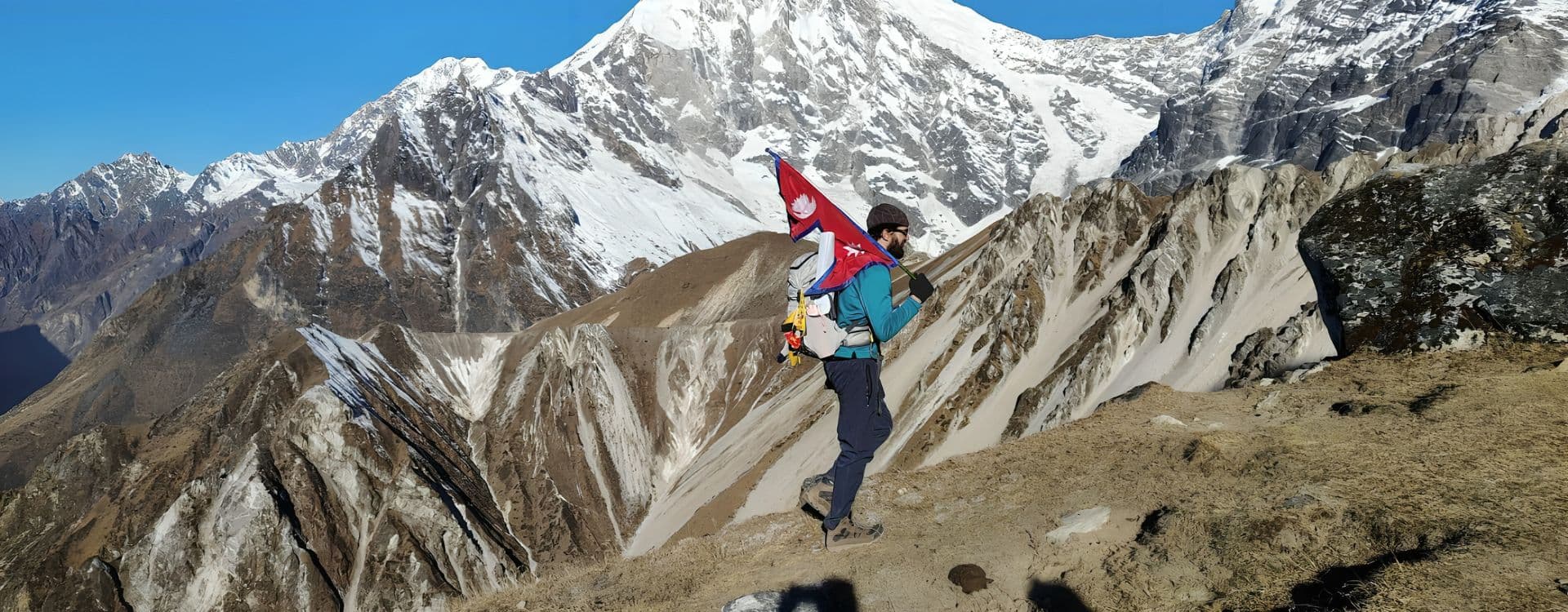
This journey through the Langtang Valley unfolded day by day with the steady guidance of Nepal Hiking Team, revealing far more than dramatic landscapes. Forest trails, high alpine villages, and quiet monasteries shaped each stage, while thoughtful planning and strong local support made every step feel confident and secure. What remained long after the trek ended was not only the memory of the mountains but also a deeper connection to the people and places that define this remarkable valley.
Day 01 – Scenic Drive from Kathmandu to Syabrubesi (Gateway to Langtang Valley)
If you’re fortunate enough to arrive at Kathmandu’s Tribhuvan International Airport in the early morning—and if you’ve had the foresight to pick out a window seat—you may be lucky enough to catch a bird’s-eye view of the tallest mountains in the world. As dawn breaks over the horizon, you’ll glimpse a vast swathe of the spectacular Himalayan mountains thrusting from their lofty bed of clouds to pierce the sky itself: a mighty range that spans the length and breadth of six different countries. But it’s here in Nepal that the world's tallest mountains lie. This little Himalayan country boasts at least eight peaks over 8,000 meters, and my wife Krista and I have flown halfway around the world to lace up our boots and trek among them.
I’ve dreamed about trekking in Nepal’s Langtang Valley for many years. Evocative words and phrases like Kyanjin Gompa, Langtang Lirung, and Tsergo Ri have fired my imagination in the months leading up to this adventure, and now my anticipation has reached something of a fever pitch. I can’t wait to tread the boards of impossibly long suspension bridges, watch the sun setting over the crags and peaks of the Langtang Himal, and share a cup of tea with friendly locals in scenic hillside cafés and teahouses. But before these dreams can be made manifest, we’ve got to navigate the hustle and bustle that is Kathmandu: the country’s capital and largest city.
We’re met at the arrivals terminal by one Hari Gurung: an experienced trekking guide at the top of his game—and an old friend, too. We had the pleasure of completing the Annapurna Base Camp Trek with Hari just a few years back, and it’s a delight to be in his cheerful company once again. One of Nepal Hiking Team’s best guides, Hari, hails from Golphu Bhanjyang in the Helambu region of Nepal, not far distant from the Langtang Valley. We’re also joined by Suhan Lama, a quiet and friendly young man who will be our porter during the trek. We really prefer to carry all the gear we bring on our backs—but Nepal Hiking Team also provides trekkers with top-rated sleeping bags and a few other trekking essentials, and it’s these that Suhan will help us carry into the mountains.
Together we set off into the controlled chaos of urban Kathmandu, where fast-moving motorbikes zip around every corner in staggering numbers. Heavily coiled bundles of electrical wires line the streets, feeding a steady stream of power to the city’s countless shops, eateries, and markets. Almost as numerous are the Hindu and Buddhist shrines on every block, speaking plainly to Kathmandu’s wholehearted embrace of both tradition and progress. The noise and activity here is a stark contrast to the peace and tranquillity of the mountains, but there’s something almost hypnotic about its rhythms—if only you allow yourself to be open to it all. This is a city that rewards open eyes and an inquisitive mind.
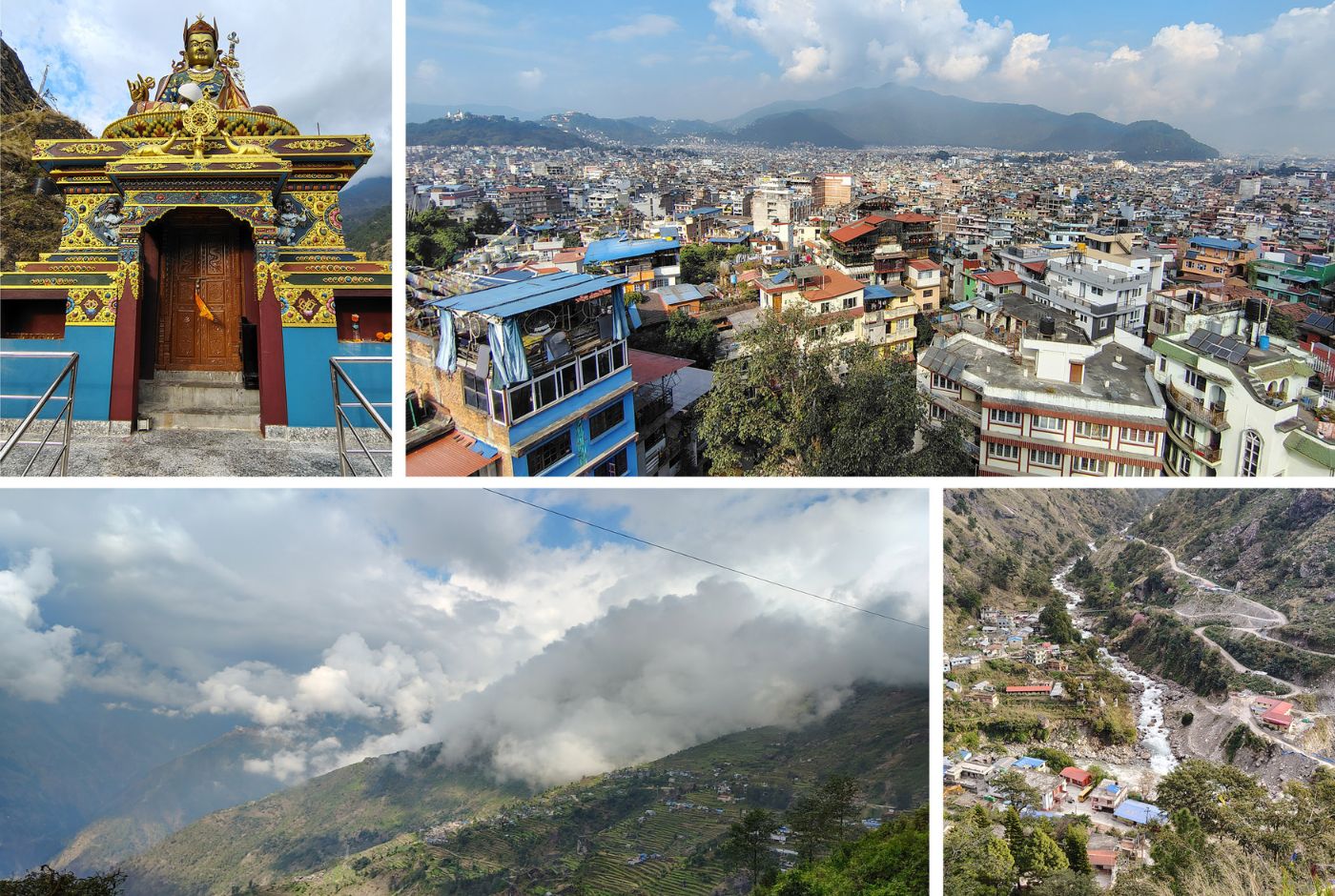
We’ve got a long drive ahead of us to reach the little town of Syabrubesi, where our adventure on the Langtang Valley Trek is set to begin. All of the literature has led me to expect a long, bumpy, and occasionally terrifying drive on poorly paved roads. And maybe things would be a bit rougher under the wet, landslide-prone conditions of the summer monsoon. But it’s late November now, and we’re pleased to encounter dry roads in good conditions, as well as clear skies and fantastic mountain views. Our drive actually turns out to be something of a breeze, and we wind up and down steep mountain switchbacks for about five or six hours to enter the gates of the Langtang National Park without any trouble at all. Sometimes the road is alarmingly narrow, and it almost always skirts just a little too close to the cliff’s edge for comfort. But this is all in the spirit of another grand adventure, and there’s something to be said for the philosophy of letting go and enjoying the ride.
When we arrive in Syabrubesi, the first thing we see is a gold-plated statue of Guru Rinpoche looking down upon us from a rounded hill on the edge of town. The benevolent eyes of this Buddhist saint peer through a screen of colourful prayer flags snapping in the wind, inviting us to approach. Guru Rinpoche is widely credited with introducing Buddhism to the entire Himalayas in the eighth century, and we’ve seen his enigmatic smile and curling moustache in gilded statues, intricate thangkas, and lovely paintings from Ladakh to Bhutan. Finding him here at the threshold of the Langtang Valley feels like a good sign, and we make the short, steep climb along a series of stone steps cut into the hillside to find ourselves standing at the feet of this statue.
It’s also a good bit of exercise. Syabrubesi is situated at only about 1500 meters in elevation—too low to really worry about any symptoms of altitude sickness. But this short hike serves as a good teaser for what we’ll be getting up to in the next few days: steep climbs, high winds, and glorious views. And this view really is nothing short of remarkable: even here, still miles from the heights of the taller Himalayas, the hills and valleys of rural Nepal spread out before us like a dream. It’s an image that stays with me as I dig into a hearty meal of fried Tibetan dumplings called momo a few hours later, allowing myself to anticipate what new sights tomorrow will bring.
Day 02 – Forest Trails, Suspension Bridges, and River Walks to Lama Hotel
We rise early this morning, ready to begin our Langtang Valley Trek. But first, there’s one essential item to address. On all of our previous visits to the Himalayas, we’ve encountered plenty of friendly dogs. Both on the streets and in the mountains, these wandering strays look at us with hopeful eyes, and I hate to disappoint them. While many travellers choose to carry around a package of India’s ubiquitous Parle-G biscuits to answer this need, the biscuits are strangely absent from all of the shops on Syabrubesi’s main drag. This is probably just as well—the biscuits have a high sugar content, and while dogs in the mountains can use the calories, they probably don’t need the sugar. We pick out a replacement brand in a little Tibetan shop across the way from our guesthouse and return to pick up our bags.
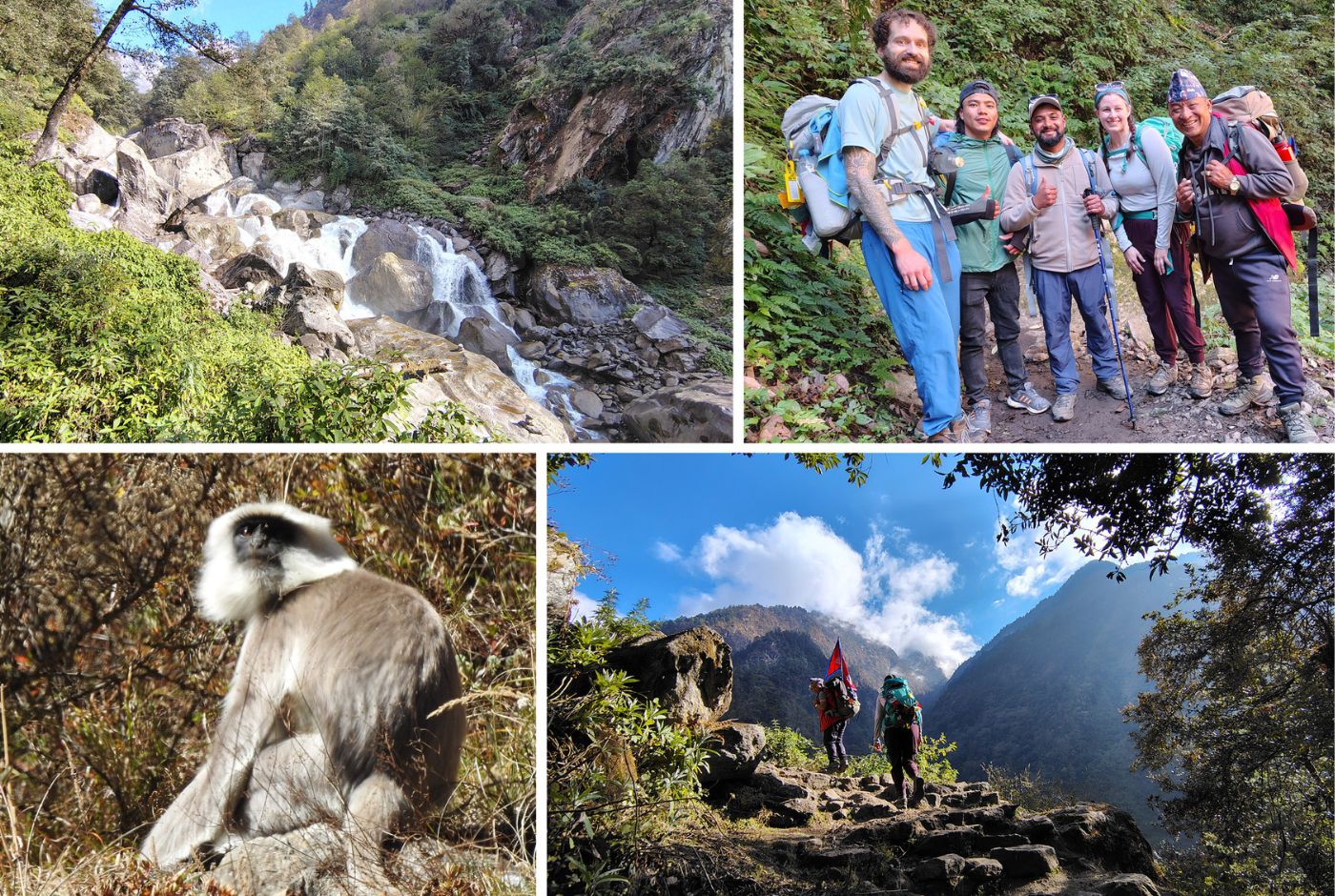
Thus armed with a pocket full of biscuits for any friendly dogs we might encounter along the way (or ponies, or yaks, as it turns out), we take our first steps on the Langtang Valley trail. Most trekkers can complete this moderately strenuous hike in about six days, and that’s the plan we’ve set out to follow. The first stretch of this unforgettable overland journey will bring us to a small community of guesthouses known simply as Lama Hotel. From there, we’ll stop at increasingly far-flung locales: Mundu and Kyanjin Gompa, where the trek reaches its endpoint. All told, the round-trip trek covers about 65 kilometers, or 40 miles, of wild alpine landscapes: lush forests, rocky slopes, and soaring mountain heights. Here in the comparatively low foothills, of course, we find ourselves navigating shaded trails winding their way through forests of rhododendron and pine. And before long, we encounter our first suspension bridge reaching across the swiftly flowing glacial meltwater of the Langtang Khola river.
Long-reaching, dramatic suspension bridges like this one are a feature of these mountains, spanning otherwise impassable gaps from one cliff to another. But it’s a mistake to think that these have been installed solely for the benefit of trekking tourists—residents in these hills rely on these bridges and trails for their own transportation and that of their pack animals. Over the course of the next week, we’re sure to encounter many different trains of donkeys and ponies heavily laden with cargo: rice, fuel tanks, packaged goods, and other necessities of mountain life. And the metal-plated planks of the bridge beneath our feet are even now slick with the ripe evidence of their passage. With one hand on the rail and the other on my camera, I step carefully across.
On the other side, something unexpected happens. When we trekked in the shadow of the Annapurna mountains with Hari just a few years ago, we were accompanied by porter extraordinaire Sangkhar Thapa: a young man with strong shoulders and a sharp sense of humor. It’s a welcome surprise, then, to encounter him on the trail today. Sangkhar is now an assistant guide, leading a group of trekkers back from the heights of the Langtang Valley. He’s also grown a beard. We stop for a warm embrace and take a photo together, marveling at the chance we've encountered one another here, today, amongst all the many disparate trekking trails across Nepal. Is it a coincidence? Is it fate? I’ve never really believed in the latter, but it feels like another good omen.
We cross a few more bridges throughout the course of today’s hike, earning occasional glimpses of the still-distant Langtang Himal along the way. The trail trends steeply up and then steeply down, over and over again. It’s also one of the warmer days on the trail, as we’re still relatively low in elevation. All of this means that I’m starting to work up a pretty good sweat as I haul my bag over each successive rise in the terrain, even in the cool temperatures of late November. Fortunately for me, there are plenty of excuses to stop and catch my breath, allowing me to savor the splendor of our incredible surroundings.
One such excuse conveniently rears its head in the mid-afternoon. We’re hiking alongside the Langtang Khola when we spot a band of gray langurs moving about in the trees on the opposite bank. These are Old World monkeys with gray-and-white fur, black faces, and large families. As we stop to watch them, we start to pick out more and more of them moving quickly along the water’s edge; jumping from the branches of one tree to another; or just sitting quietly and staring in our direction. They aren’t particularly threatened from a conservation standpoint, but it’s still a rare treat to see so many of them gathered peacefully in one place.
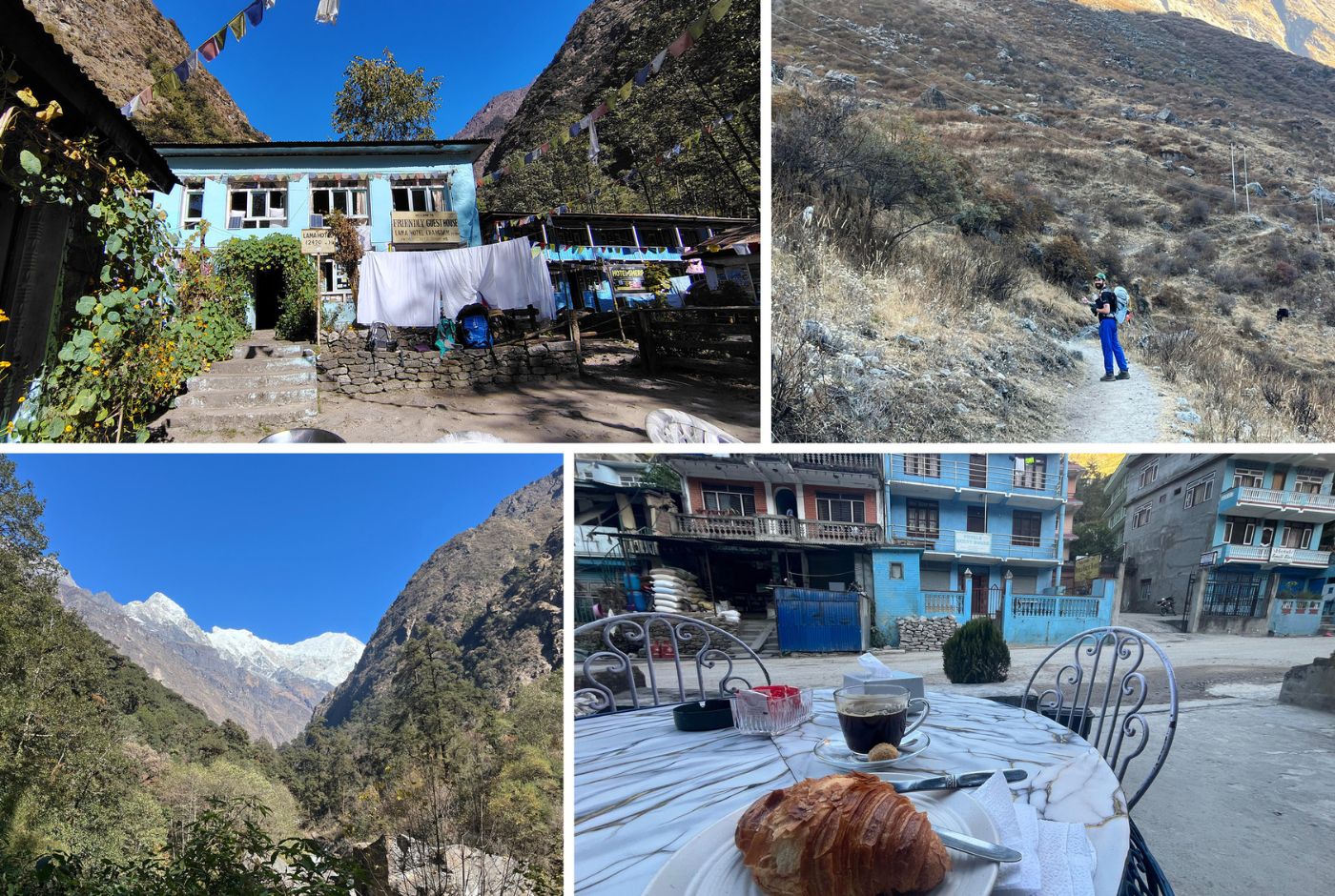
We arrive at Lama Hotel in the late afternoon, and our guesthouse is pretty typical of Nepali trekking lodges: clean, basic, cold, and offering a surprisingly robust selection of meals. This is one of my favorite experiences while trekking in Nepal. Because teahouses are invariably owned by locals, you get a firsthand experience with their culture while enjoying authentic food and good camaraderie all around. Tonight is no exception.
Day 03 – Gradual Ascent Through Langtang Village to Peaceful Mundu
The day dawns bright and crisp—and cold. The mountains are drawing nearer with every step, as we climb out of the subtropical lowlands and into real mountain territory. After an hour or so, we find ourselves entering a broad meadow lined with firs, where we cross paths with a Western family traveling toward the Langtang Mountains. With them is their son: a fair-haired boy of maybe 10 or 12 years. He approaches us with a smile and a plastic bag full of Snickers bars. Do we want to buy any? Well, no—if I were going to buy any candy, it’d be from the local teahouses, which actually depend on our custom. But I suppose you can’t fault his entrepreneurial spirit, and the worst-case scenario is that he’s a kid stuck with a bag full of candy. Hardly a tale of woe.
But there are real and serious tales of woe in these mountains. Even 10 years later, every conversation about the Langtang Valley is couched in terms of the 2015 earthquake that devastated much of the country and cost nearly 9,000 lives. You really only need two measurements of time in this part of the world: before the earthquake, and after the earthquake. Here in Langtang Village, you’ll find two memorials to the many lives lost when the village was destroyed by an unprecedented landslide of rock and snow. One commemorates the army encampment that once stood on the outskirts of the town, while another pays tribute to both locals and visitors caught in the midst of this sudden disaster. It’s a sobering reminder of the fickle tectonic forces that created the Himalayan mountains, and I can’t help but reflect upon the tragedy as we pass over the landslide itself.
Beneath our very feet is the wreckage of the entirety of Langtang village, wiped out in an instant when the earthquake struck. Though we tread carefully, a path has been worn into the rubble over the course of a decade, and it really isn’t especially treacherous. No, this is a different sort of weight. That a new Langtang village was quickly built just a short walk away speaks, I think, to the incredible resiliency of the Nepali people—especially here in the unforgiving environment of the mountains.
It’s also near Langtang village, where I encountered my first bakery on the Langtang Valley Trek, or at least the first bakery that caught my attention. On a large boulder, the words BAKERY and ESPRESSO are splashed in white paint. Another good sign, if you will. I’m on the hunt for the best cinnamon roll in these mountains, and we stop here so I can eagerly tuck into the first contender. Its flavor is rich and sweet, but we’re well into the mid-afternoon now, and the once-soft pastry has grown dry and brittle. I’m sure it would’ve been a treat when it was fresh in the morning. But then, there’s no such thing as a bad cinnamon roll, and I have high hopes that I’ll find an even better one tomorrow.
You see, most travelers end their trek here in Langtang, but we’ve opted to push on to Mundu. We’re hoping to earn even better mountain views as the sun goes down over the 6378-meter summit of Gangchempo tonight. And we aren’t disappointed: right around five in the afternoon, we’re treated to the natural splendor of the sun shedding its golden glow across the distant face of the mountain, briefly striking it aflame with a fiery orange hue that’s as unexpected as it is lovely.
We’re staying at the Golden Holiday’s Guesthouse: a lovely structure with traditional architecture, featuring solar-powered hot showers and a warm, welcoming common area—features increasingly essential as we venture higher into the mountains, where subfreezing temperatures are a fact of life. The guesthouse is operated by a husband-and-wife team, and they prove to be the most welcoming and engaging hosts of our entire Langtang Valley Trek. In the common area, I find myself lingering at the couple’s little Buddhist shrine and marveling at photos of our hosts’ pilgrimage to Kailash: arguably the most holy mountain in all of the Himalayas. The guesthouse also organizes and leads treks to nearby Yala Peak, a 5500-meter summit that rewards climbers with stupendous views of the 8000-meter Shishapangma. Do we want to try our luck? Well, maybe next time.
For tonight, we’re content to toast our feet by the woodstove whilst sipping a dram of Old Durbar whisky. I’ve tucked a little bottle into my trekking pack, and unlike the rest of my luggage, it’s destined to get a little lighter each night. Like most of Nepal’s whiskies, it’s made with imported Scotch malt and paired with Himalayan spring water to create a warm, welcoming taste that goes down easily, especially in such cozy surroundings. Drinking at high altitudes usually isn’t recommended for visitors still acclimatizing, but I’ve never been worse off for a minor indulgence. The important thing is to stay hydrated. And thankfully, the spicy chili sauce next to my meal tonight has me reaching for my water every thirty seconds. I’m suffering as I eat it, but I love it. Maybe that’s a metaphor for trekking in the first place?
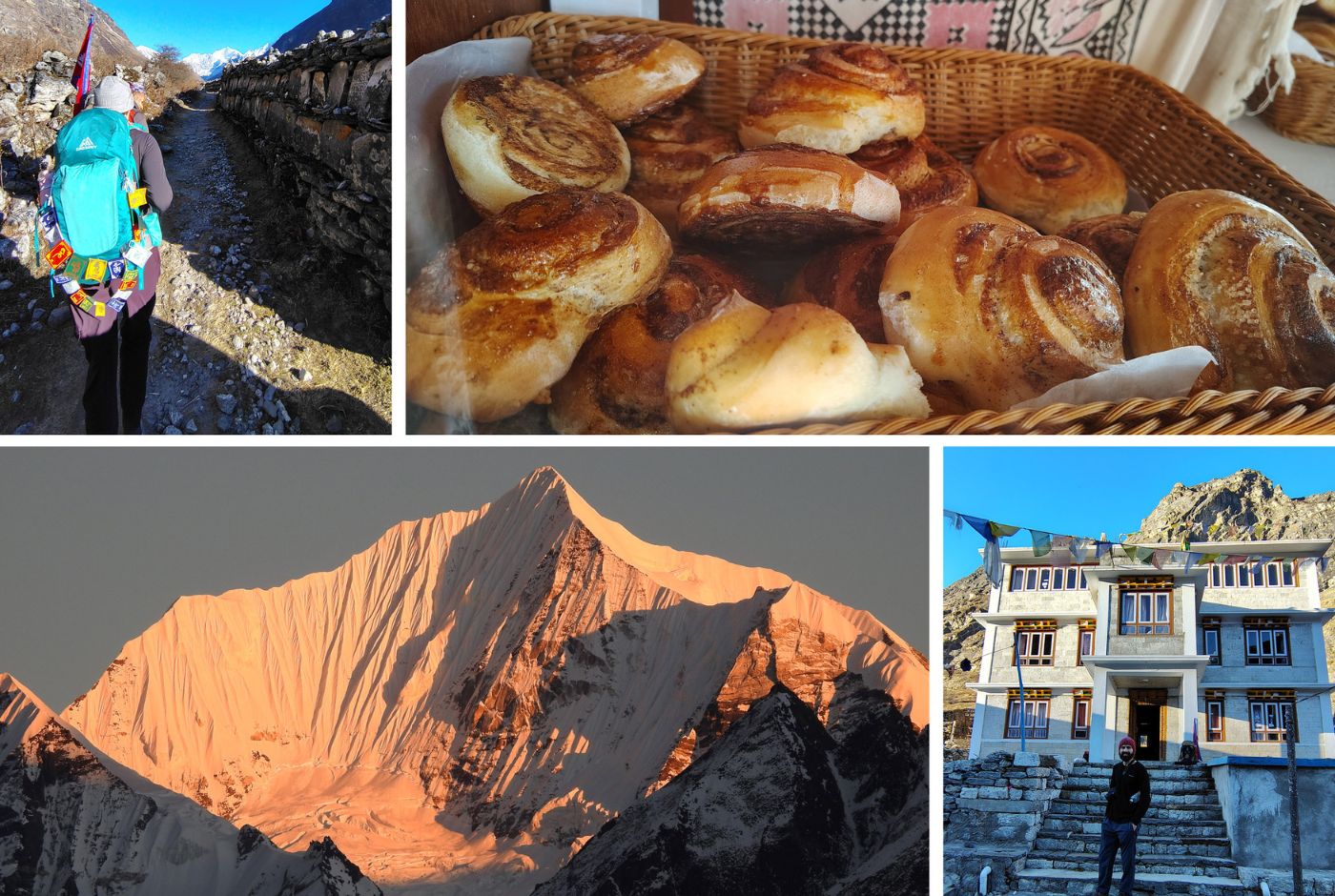
Day 04 – Mani Walls, Glaciers, and Mountain Views to Kyanjin Gompa
It’s hard to believe that we’ll be pulling into Kyanjin Gompa today after a relatively short few hours on the trail. Not so very long ago, Kyanjin Gompa felt like it rested at the end of the world: distant, inaccessible, impossible. But it’s only taken us three days of walking to reach this tiny settlement clustered amongst the towering peaks of the Langtang Himal. The world has gotten a little smaller, I think, and this makes a particular kind of traveler feel regret for what has been lost over the years. I’m of a different philosophy: the residents of Kyanjin Gompa deserve access to the roads that now reach past Syabrubesi. They have every right to food, medicine, supplies—all of the necessities of life. There’s an unpleasant sense of elitism in certain corners of the trekking community, where travelers would rather see locals consigned to poverty so that they can maintain the impression of an unspoiled mountain paradise. Not so for me.
But most of our fellow travelers aren’t so disagreeable. Indeed, one of the pleasures of hiking in the Himalayas is the chance to meet and re-meet one’s fellow trekkers. These are necessarily brief friendships, forged in the moment of shared experiences and destined to be forgotten as the many miles roll on beneath one’s feet. Today we catch up with two separate groups that we’ve connected with here and there along the trail, taking a few minutes to share our experiences and discuss our plans for the following day.
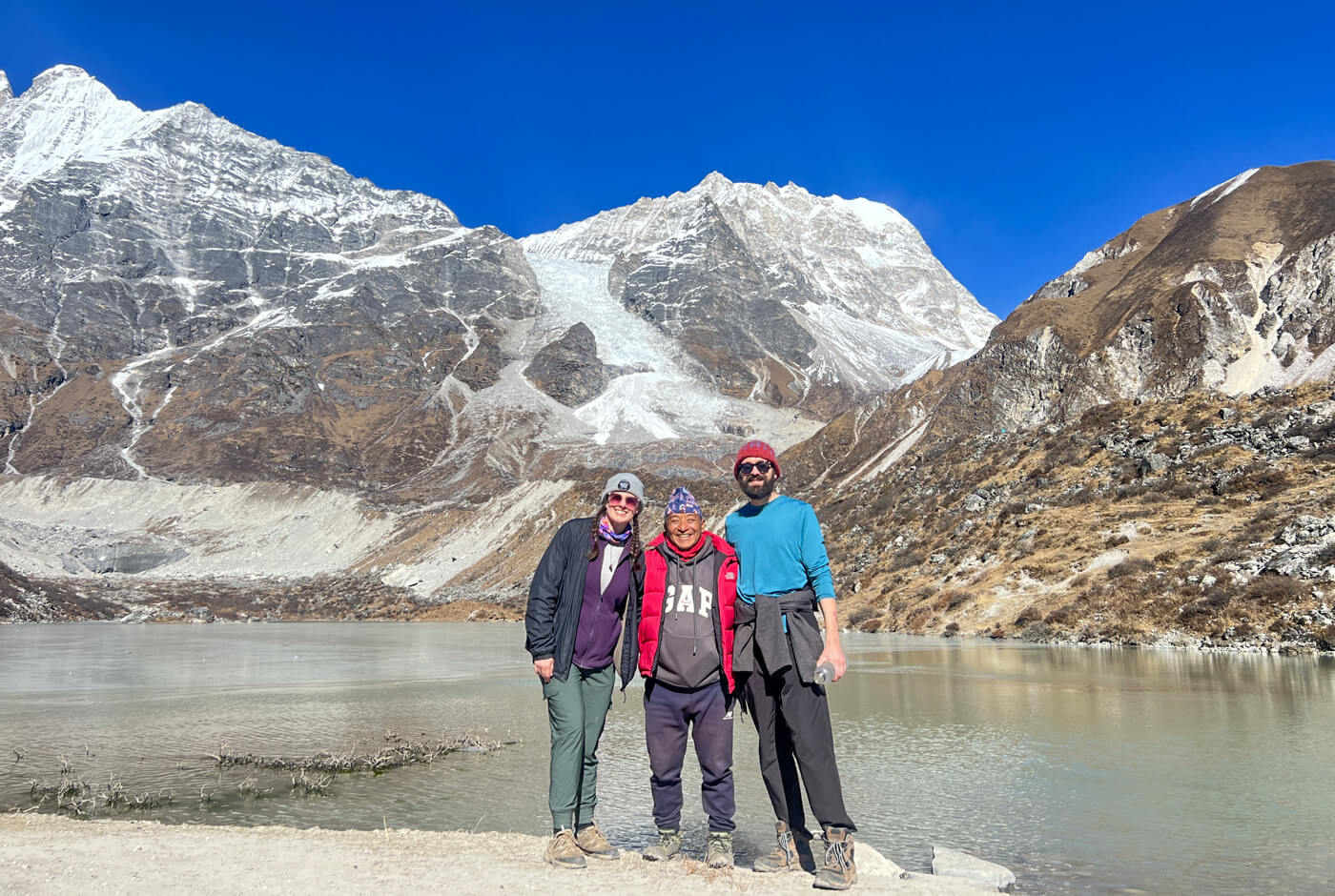
When we reach Kyanjin Gompa, we have to consider two world-class hikes that most trekkers simply can’t miss. The first is Kyanjin Ri: at just under 4800 meters in elevation, this marvelous viewpoint offers unforgettable views of the mountains Langtang Lirung, Changbu, and Yubra, among others. Most of the hikers we meet will be tackling this climb tomorrow morning. But we make a different choice. With limited time in the mountains, we opt for the higher, even more spectacular summit of Tsergo Ri. But more on that later—first, we’ve got to reach Kyanjin Gompa.
We follow today’s trail past a series of mani walls, which are carefully built with many disparate stones—each of which is carved with the Buddhist mantra om mani padme hum: praise to the jewel in the lotus. To expound upon the significance of this phrase would be a task well beyond the scope of this little blog; suffice it to say that it’s the most common mantra in the Himalayas, observed and repeated with almost unthinking reverence by just about everyone who treads these mountain trails.
Ultimately, these trails do lead our group of four to Kyanjin Gompa itself. The village spreads out before and below us as we crest a little ridge, and I can see at once that it’s one of the most beautiful places I’ve ever had the pleasure of visiting. The town itself is a smattering of colorful guesthouses and cafés, and from our perspective we can see the prayer flags of the local monastery (the titular gompa) snapping briskly in the mountain winds. Above the village, an unblemished blue sky perches atop the glaciated summits of the Langtang Mountains. Past the perimeter of Kyanjin Gompa, a series of thin trails peters out into the hills and mountains, disappearing from sight. I smile to myself—there’s still plenty of unblemished wilderness out there.
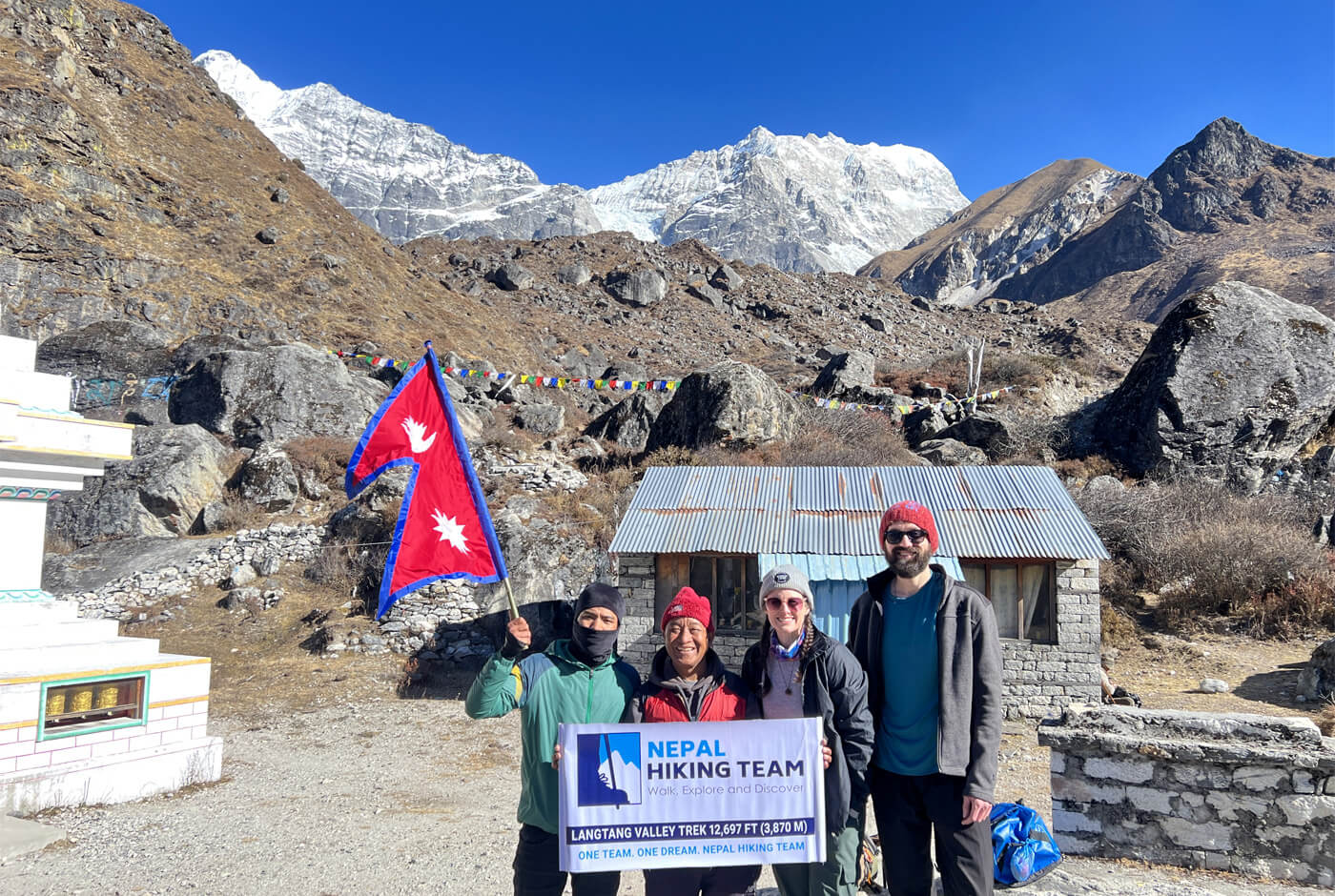
But I’m looking for something a little less wild first, as my quest to locate the best cinnamon roll in the Langtang Valley continues. I’ve got plenty of choices to consider here in Kyanjin Gompa. First up is the Dorje Bakery Café and Coffee Center, which greets most trekkers just as soon as they arrive in the village. The cinnamon rolls here are baked lightly, yielding a pastry that's just this side of golden brown. They’re also positively packed with cinnamon, and they pair really nicely with a hot mug of real coffee—there are no instant grounds to be found here. Next up is the Kyangjin Gumba Bakery. Its name reflects an alternative spelling of the town in which it’s located, but there’s nothing unfamiliar about its cinnamon rolls: they’re round and slightly flattened, topped with cinnamon sugar rather than frosting. This is just the way I like them—but these rolls are whoppers. I heft one in my hand and quail at the thought of trying to finish it just a short time after enjoying my previous roll. Into my pack it goes—I think I’ll save it for the summit of Tsergo Ri.
We spend the rest of the afternoon doing a little light hiking, because we really haven’t had enough of it so far. And right at the outskirts of Kyanjin Gompa, a rocky path beckons us enticingly into the hills. A few words painted on a rock offer a vague direction: left to the lake, right to the glacier. We opt for the left, picking our way downhill and across a cold stream before climbing for 10 or 20 minutes to earn another great view of Kyanjin Gompa itself. I’m surprised at just how quickly the village has receded behind us: I can only just faintly discern the bright splash of pink which represents the Namaste Guest House, where we’re staying for tonight. Just beyond, the mountains of the Langtang Himal sparkle like diamonds in the unclouded sky, dwarfing the village on a scale that can only really be conceptualized in geological terms.
When we arrive at the glacial lake, I’m surprised. I had expected blue, reflective waters. Instead, the pool has frozen over almost entirely, appearing sleet-gray in the late-afternoon light. From here, we can get a great look at the massive Langtang Glacier. It used to be much bigger, of course—climate change spares no country, and the Himalayas are disproportionately affected—but it’s still a marvel, and I’m thankful that we’ve made the extra effort to reach this viewpoint. Walking around the shore of the lake, we find a spot that hasn’t quite frozen yet and, in the absence of suitable stones, try our luck at skimming little chunks of ice across its surface. Then it’s back along the same trail to return to our guesthouse. Again, we easily spot its bright color from the hills overlooking the lake. I think you might be able to spot it from space. After dinner, we retire early. We’ll need plenty of rest, because tomorrow’s bound to be a long day.
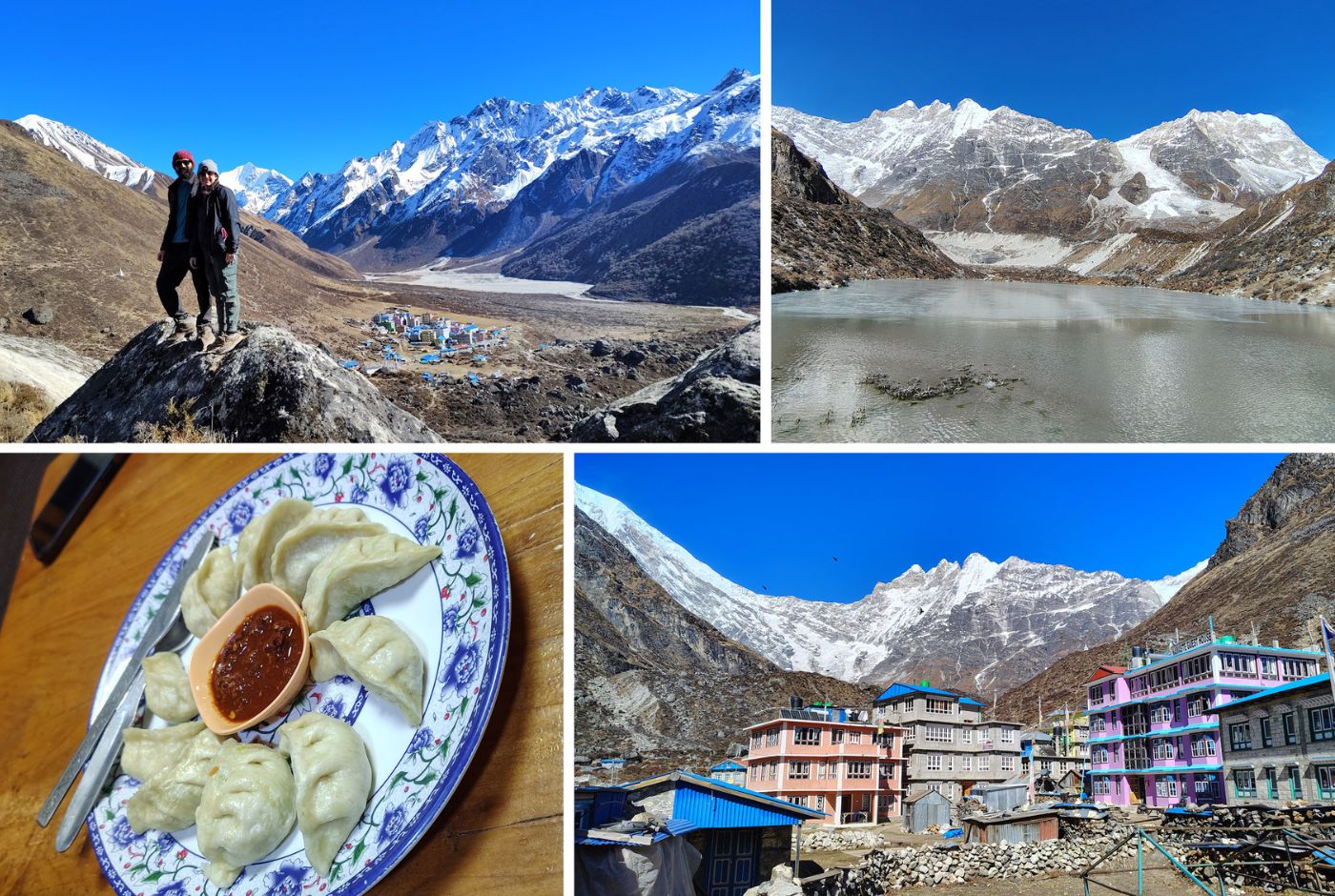
Day 05 – Sunrise Climb to Tsergo Ri (5,050m) and Descent Back to Mundu
Waking in the predawn darkness and strapping headlamps to our beanies, we’re ready to set out from Kyanjin Gompa and begin the arduous trek to the mountain viewpoint of Tsergo Ri, or Cherko Ri. I’ve already said that this represents the more spectacular of the two viewpoints that most hikers pursue from Kyanjin Gompa. And I’m being very particular when I refer to this as a mountain viewpoint. By most accounts, the summit of Tsergo Ri sits at about 5050 meters in elevation—higher than any mountain in the continental United States and higher than almost anything in Europe. And just look at my picture of this thing—what else could you call it, if not a mountain?
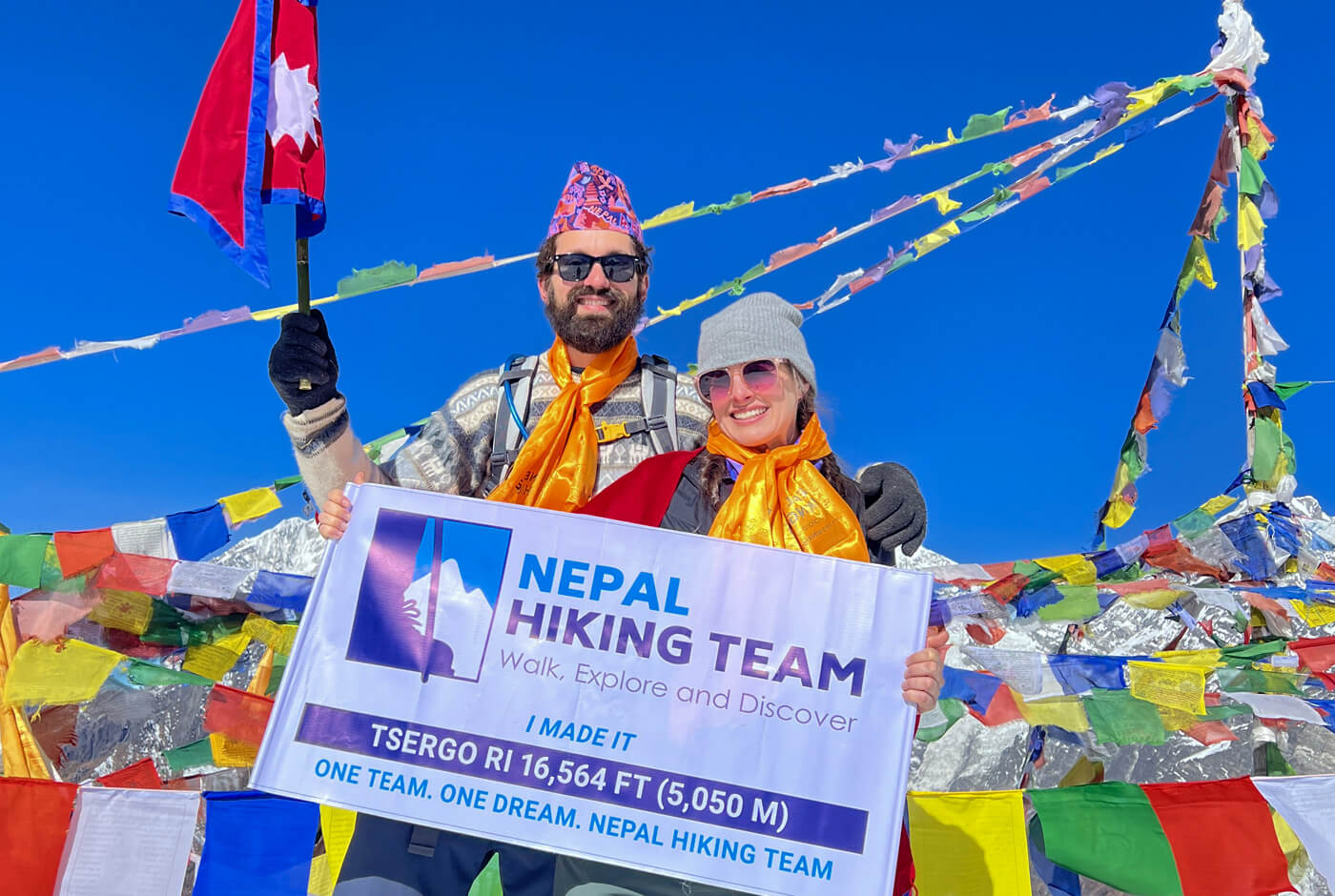
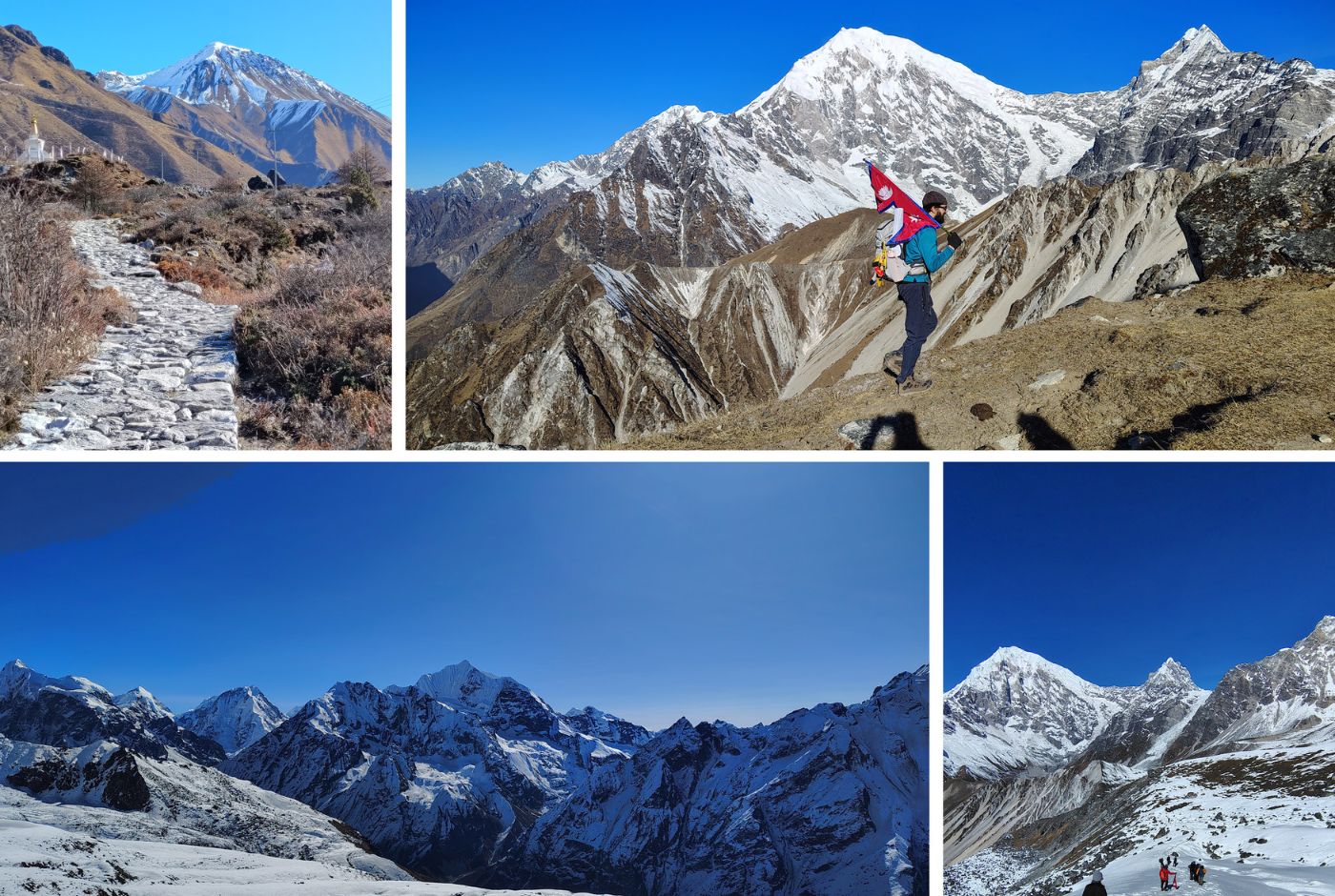
Well, here in Nepal, this kind of summit is just a hill. Never mind that it takes us three hours to climb to the top, laboring slowly in the rarefied atmosphere. Never mind that the last stretch of the hike involves scrambling along steep slopes of loose scree, tromping through shin-deep drifts of undisturbed snow, and plunging between surprising extremes of temperature as the sun alternately peeks out from behind the mountains and then plunges itself shyly back into shadow. Nothing in Nepal is called a mountain unless it’s at least 6,000 meters tall. I grumble to myself about this as I pant and sweat my way along the steep pathways leading into the sky.
But whether you want to call it a hill or a mountain, there’s no denying that the view from the top of Tsergo Ri is nothing short of astonishing. It may be the single most beautiful spot I’ve ever stood, and the four of us are overwhelmed with good spirits as we lift our arms to the sky and celebrate the beauty of our surroundings. Hari actually breaks out into a dance before doling out a few surprises that he’s secretly hauled up the mountain: a lovely shawl for Krista and a traditional hat called a Dhaka Topi for me. We’re humbled and delighted by these unexpected gifts, and I dig into my own bag to retrieve another sort of treasure: the giant cinnamon roll from back in Kyanjin Gompa. We break it into pieces, the four of us savoring its sweetness while we take in the full extent of our surroundings.
And it’s really a place of impossible beauty. We’re perched in the midst of a veritable tornado of prayer flags: thousands of them are strung from one line to another, rippling softly in the cold wind and creating an otherworldly, all-encompassing atmosphere of color and sound. And all around us, of course, lies a panorama of some of the Himalayas’ most beautiful mountains. We can see across the Langtang Himal and even peer into not-so-distant Tibet. Hari gives us a quick lesson, rattling off the names of these peaks: Shishipangma (8027m), Langtang Lirung (7234m), Dorje Lhakpa (6966m), Gangchempo (6378m), Changbu (6251m), Yubra (6035m), Naya Kanga (5863m), and Yala Peak (5500m)—just to name a few. It’s as sublime a sight as I could have hoped for, easily rivaling the views from Annapurna Base Camp that we earned with Hari on our last trek in Nepal—and it’s made all the sweeter by the hard work it took to get here.
But after about 20 minutes at the summit, we’ve got to head back down. And going back down is always more complicated than going up. For one thing, your initial ascent is full of anticipation and wonder at the promise of incredible mountain views—and once you’ve been to the top, that anticipation slowly ebbs away. For another thing, it’s hell on the knees. For that reason, we take things slowly, but we’re still able to descend from Tsergo Ri in about two hours. We retrace our route all the long way down, occasionally diverting onto yak trails (or, as he calls them, Hari trails) where they offer a gentler path. Before long, the colorful guesthouses of Kyanjin Gompa appear around a bend in the mountains.
We aren’t done for the day just yet, though. While most trekkers spend two or three nights here in Kyanjin Gompa, we choose to return to Mundu. There’s still plenty of daylight, and we’ve each got a bit of energy left to burn. And so we stop briefly for lunch and tea at our guesthouse, taking some time to repack our bags before hitting the trail. With Kyanjin Gompa at our backs, we then take our first steps on the way back out of the mountains. You might think this would come as something of a disappointment, and I suppose it does. It’s a shame to leave this breathtaking Himalayan amphitheater behind, especially when we’ve only just arrived. But we have many miles yet to go, and we’ll be in the company of these mountains for a while yet—and besides, there’s no telling what adventures tomorrow might bring.
Day 06 – Long Descending Trek Through Woodlands Back to Syabrubesi
Our last day in the Langtang Valley has arrived all too soon. I’m not ready to leave these mountains behind, and I’m not ready to say goodbye to the friendly people who call this valley home. And right now, at least, I’m not even prepared to be done trekking. It’s an invigorating experience: testing the limits of my endurance by hiking long miles at elevation while carrying a heavy bag. Moreover, Hari and Suhan have made for an unforgettable trekking team, and finishing our trek will necessarily mean parting from their company. So I make a quiet promise to myself: I’m going to savor every last moment of today’s descent from the mountains. And I’ll have plenty of moments to savor.
That’s because we’re planning to cover almost 20 miles of trail today, pushing all the way back to Syabrubesi rather than stopping at Lama Hotel for the night. Like most the Langtang Valley Trek, the terrain on today’s trek is comprised of what’s called the Nepali Flat—which is to say that there’s a lot of up, and there’s a lot of down, and they sort of cancel each other out over the course of many hours on the trail. But there’s no mistaking the simple fact that we are descending from the heights of the Langtang Valley, if slowly: scree-strewn slopes and long stretches of treeless mountain paths are beginning to give way to rhododendron forests and little stands of pine and deodar cedar. Before long, we’re genuinely back in the woods, marching alongside the steady waters of the Langtang Khola. When I’m not staring at my feet in an effort to avoid tripping and stumbling, I’m marveling at the sheer volume of water this river carries down from the mountains. More than a few people have lost their lives to this river, and it’s easy to see how an unlucky slip could end in tragedy.
Still, we choose our steps carefully, and Hari’s pathfinding skills are beyond reproach. We make steady progress this way, retracing our steps along the trails of the Langtang Valley and reacquainting ourselves with the Himalayan vistas and villages we’d left behind just a few days ago. But while Hari careens easily down the mountainside with all the ease of long experience, we move more slowly, pacing ourselves to ensure that we don’t run out of stamina before the day is through. And it is a long day: we pull into Syabrubesi at last in the late afternoon, with maybe about an hour of daylight remaining. We approach the town from the opposite bank, and we need to make a slight climb to reach the street where our hotel is located. I laugh: Hari has found one last staircase for us.
Back at our hotel, we take a much-needed rest before gathering in the communal dining hall to dig into a hearty meal of thenthuk, Sherpa stew. This is a hot vegetable soup, positively brimming with soft, hand-pulled noodles. It’s the perfect reward for our long day of strenuous hiking on the trail, and I find myself reflecting on the miles we’ve covered as I enjoy one warming spoonful after another. From lowland jungles to snow-covered mountain summits, we’ve seen the best that the Langtang Valley Trek has to offer. We’ve also been lucky enough to make a few friends along the way.
In the morning, we would set out for Kathmandu, hoping to catch a few final glimpses of the Himalayas along the way. We wouldn’t be disappointed, either: the Ganesh Himal and Dorje Lhakpa shone like beacons in the clear skies of November, easily visible from the road that twists and turns over and across the terraced hills of Nepal. But all of that would be saved for tomorrow. For now, we’re happy to enjoy one last night in the Himalayan town of Syabrubesi, sleeping soundly under the watchful eye of the golden Guru Rinpoche.
Planning a Trip to Nepal? Make an Inquiry